One habit many drivers don’t even notice they’re doing is crossing hands on the steering wheel. While many experienced drivers do this, driving instructors will encourage learners to use the push and pull method. So, with this in mind, can you cross hands in a UK driving test?
The truth is, crossing your hands is not a disaster. But there are rules, expectations and a few easy ways to turn a perfectly good drive into unnecessary faults on your test. In this article, we will look at exactly what examiners look for, when crossing your hands is acceptable, and how to steer with confidence so that you can focus on passing, not panicking.
- Is it ok to cross hands on your driving test?
- The best hand position on the steering wheel for a driving test
- Can you fail your driving test for crossing your hands?
- Do you have to keep both hands on the wheel during a driving test?
- Can you drive with one hand on a driving test?
- Steering with one hand – when it is and isn’t allowed
Is it ok to cross hands on your driving test?
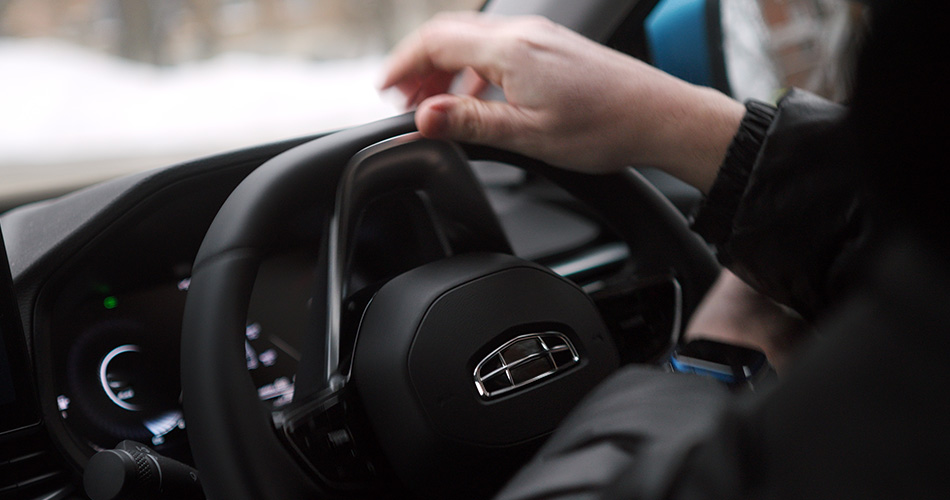
As long as you have full control of the vehicle and aren’t crossing your hands a lot, you can cross your hands during a UK driving test without it being an automatic fail. However, whilst you are learning to drive, your instructor will actively discourage crossing hands when steering, especially during the beginner stages when you are still learning to control the car.
This is because there are some safety concerns around crossing your hands whilst driving a vehicle. For example, if you hit a pothole in the road and your hands are crossed, it may cause you to lose control of the vehicle, causing an accident. In addition, crossing your hands can limit how far and how quickly you can turn the steering wheel. In an emergency where you need to apply extra steering quickly, this can be quite dangerous.
One of our driving instructors in London recently said:
“I was previously teaching a driver who was taking driving lessons in preparation for an extended driving test after a ban. He was used to crossing his hands when driving and had never lost control of the vehicle; however, on the day of the test, he tried to steer without crossing his hands. As this was unnatural for him, it caused him to lose control and clip the kerb during his driving test, which resulted in a driving fault.”
It is better to keep both hands on the wheel as much as possible to maintain control, especially on your test when nerves can make steering trickier.
The best hand position on the steering wheel for a driving test
Whether you are learning with one of our driving instructors in Manchester or in a small town such as Toddington, you will be taught how to turn the wheel with your hands at the “10 to 2” or “9 to 3” position. You can then feed the wheel through your hands using a “push and pull” motion. This will give you good control, balance and visibility of the dashboard whilst you steer, and is a straightforward position to master, especially as you get to grips with the basics of driving.
From here, your hands will naturally move as you steer around corners and roundabouts. This is completely fine. The main things to remember are to:
- Keep both hands on the steering wheel as much as possible.
- Steer in a smooth and coordinated way.
- Avoid sudden or jerky movements.
- Avoid letting the wheel spin freely.

Can you fail your driving test for crossing your hands?
Your examiner will be assessing your control of the car on the driving test marking sheet throughout your test. They will be checking that your steering is safe, smooth and controlled. As long as you are handling the vehicle safely and completely in control, you will not be marked down.
It is just a popular myth that crossing your hands on your test will automatically result in a fail.
Do you have to keep both hands on the wheel during a driving test?
In most situations on your test, you will be expected to keep both hands on the steering wheel when possible to show that you are fully in control of the car. This is particularly important when you are driving at higher speeds, approaching hazards, or navigating through junctions and roundabouts.
If you are regularly driving one-handed when there is no need to, or steering carelessly, it could be marked as a fault. As a rule of thumb, if both hands can be on the wheel whilst you are driving, then they probably should be.
Can you drive with one hand on a driving test?
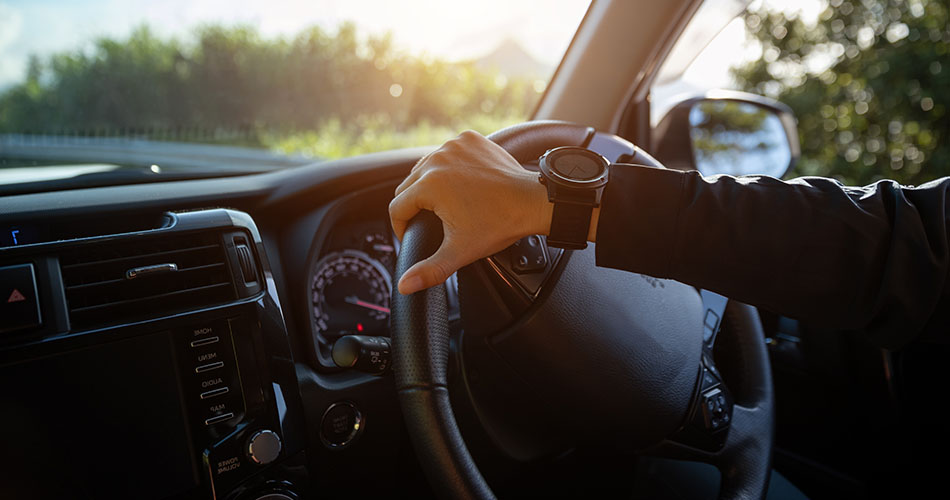
Over time, an experienced driver can develop the bad habit of steering with one hand. However, steering with one hand during your driving test could result in receiving a fault from the examiner. Both hands should remain on the steering wheel, unless you have to operate controls inside the car.
Steering with one hand – when it is and isn’t allowed
It is acceptable to have just one hand on the steering wheel during your test if you need to operate a control in the car. Examples of such controls include:
- Using the gearstick to change gears.
- Turning on the demister.
- Using the handbrake.
- Putting on the windscreen wipers.
- Turning on the fog lights.
However, once you have finished using these controls, you should immediately go back to having both hands on the steering wheel, ideally in the “10 to 2” or “9 to 3” position.
You could also steer with one hand on the steering wheel whilst you are slowly reversing, if this will give you more visibility. For example, when you need to look out of the back window when performing a manoeuvre, you may find you can get into a better position with one hand on the steering wheel, and one hand resting on the passenger seat.
Final thoughts on crossing hands whilst driving
Our driving instructors at driveJohnson’s will do everything they can to ensure you are a safe driver, equipping you with all the skills you need to stay safe on the roads for life. That said, after completing driving lessons in Ipswich, Glasgow, or anywhere else in the UK, most drivers will start to develop their own driving style. A few bad habits creeping in along the way are pretty inevitable. The important thing is to recognise when these habits could affect your safety and, as long as you can confidently control the vehicle, crossing hands is acceptable once you are more experienced.
You should always drive with both hands on the steering wheel, unless performing one of the necessary actions previously mentioned. Strong steering habits don’t just help you pass your test, but help keep the roads safe for everyone long after your L plates come off.

Written by Anthony Johnson
Grade A - 51/51
ORDIT Registered Trainer