Traffic can be unpredictable, and stopping in the wrong place can quickly lead to trouble. Understanding no stopping signs will show you where you are not allowed to stop your car, and help you avoid costly consequences.
Whether you’re driving through busy streets in a city or on quieter suburban roads, recognising and respecting a no stopping sign is a key skill for any driver. This guide breaks down the types of no stopping signs, what they mean, and the exceptions you might come across when you are out on the roads of the UK.
- Which sign means no stopping?
- What does a no stopping sign mean?
- Types of no stopping signs
- No waiting vs no stopping sign
- Can you park in a no stopping zone?
- Is there a fine for stopping in a no stopping zone?
- Red Routes and congested areas
Which sign means no stopping?
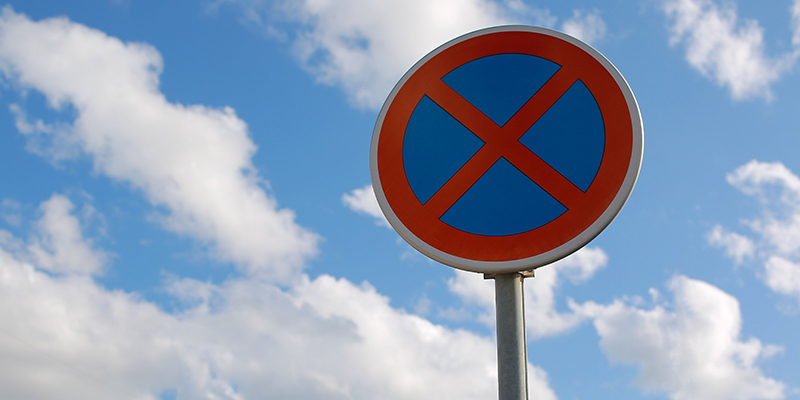
The no stopping sign is usually easy to spot once you know what to look for. It’s a blue circle with a red border and a red diagonal cross, either single or double, and sometimes accompanied by extra text indicating times or exceptions.
What does a no stopping sign mean?
Generally, a no stopping sign means you cannot stop your vehicle at any time in the marked area. Some signs state specific times in which you are allowed to stop there, so always read any additional text written on the sign.
It’s important to try to spot these road signs early, especially in busy urban roads or on red routes where enforcement is strict. With practice, recognising them will become second nature and will help you drive confidently.
Types of no stopping signs
There are different types of no stopping signs on the roads that have different restrictions. It’s common for new drivers to misread these signs, so always carefully check both the symbol and any writing on the sign. This will help you feel confident in telling these signs apart from standard no stopping signs so that you can respond correctly to them every time.
We have listed the different types of no stopping signs below.

Clearway no stopping sign
One of the most common types is the clearway sign, often seen on A roads, near train stations or at busy junctions. They have a blue circle with a red border and a single red cross, and sometimes a text plate underneath indicating times.
These signs indicate areas where stopping is prohibited, either permanently or during certain hours, usually to prevent congestion at peak times. Even a brief stop can block traffic and result in a fine.
It is important to be able to spot these signs and understand them, so your driving instructor will ensure that you can identify them. Whether you are taking driving lessons in Leicester, Glasgow, or Newport, you will find yourself practising awareness of clearway signs so that you feel fully confident of them before you have your licence.
No stopping at any time sign
A no stopping at any time sign is one of the strictest types of no stopping signs you will encounter on UK roads. It is usually a blue circle with a red border and a single red diagonal cross across it, as well as text saying “No Stopping at Any Time”.
These signs are usually placed in locations where stopping for even a short time could be dangerous, including places such as:
- Busy junctions
- Roundabouts
- Narrow streets
- Pedestrian crossings
- City streets with heavy traffic
As the name suggests, this sign means that you are not allowed to stop your vehicle in the area under any circumstances, not even for a moment.
No stopping except buses sign
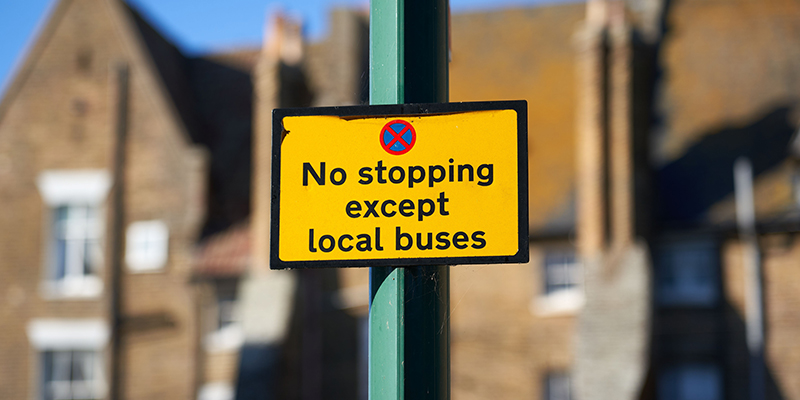
Sometimes, a no stopping sign will allow buses to stop but not other vehicles. You can easily tell the difference between this and other no stopping signs because, as well as the blue circle with red border and cross, it will also have a bus symbol and text underneath that reads “Except Buses”.
These signs are designed to keep bus lanes clear while preventing other vehicles from stopping in them. Buses are allowed to pick up or drop off passengers, but all other road users need to keep moving.
These areas are often enforced by traffic cameras, so check the full sign to make sure you respond correctly.
No waiting sign
These signs are usually a blue circle with a red border and a single diagonal red line running across it. Often, there is a small text plate underneath specifying the hours the restriction applies, such as “Mon–Fri 8am–6pm”.
A no waiting sign tells drivers they cannot park or leave their vehicle standing for extended periods, but short stops, such as picking up or dropping off passengers, are usually allowed.
No waiting vs no stopping sign
It’s easy to confuse no waiting and no stopping signs, but the difference is important. No waiting signs allow temporary stops, whereas no stopping signs mean you cannot stop at all.
A good way to tell the difference is to check if the blue circle on the sign has a diagonal red line or a red cross. The cross means stopping is never allowed, so you know that this is a no stopping sign.
Can you park in a no stopping zone?
The short answer is no. You cannot park or even stop briefly in a no stopping zone. This is to keep traffic flowing safely and stop areas from becoming congested with traffic. If you park in a no stopping zone on your driving test, then it will be marked as a serious fault.
Always check the road signs to make sure you don’t confuse these zones with areas where stopping or waiting is allowed. If you are taking driving lessons in Northampton, Northwich, or elsewhere with driveJohnson’s, our instructors will always emphasise checking signs carefully before you pull over, so that you never mistake a no stopping zone for a safe parking spot.
Top tip from Robin Palmer, one of our driving instructors in Hinckley:
‘If you are looking for a suitable place to pull up on the left and stop, and you are in a no stopping area, keep your eyes peeled for the “end” sign. Where a clearway/no stopping area starts, there must be an end too. There will usually be one sign at the end. You won’t see repeater signs. Keep glancing to the left for the big red cross sign with a blue background, stating “End” beneath.’
Is there a fine for stopping in a no stopping zone?
If you park in a no stopping area, the consequences are a fixed penalty fine and, depending on how serious or dangerous the place is, may even result in a motoring offence resulting in points on your driving licence.
While the penalty may vary depending on where you are, the principle is the same: stopping in these zones is both unsafe and potentially very costly.
Red Routes and congested areas
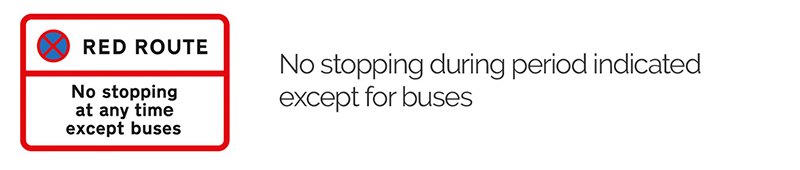
Red routes are common in London, Birmingham, and other major cities. These main roads are designed to keep traffic flowing efficiently, and they strictly enforce the rules within them. Even a small stop can result in you receiving a penalty.
Red routes can seem intimidating at first, but as long as you keep a careful eye on the signs, you can drive through these busy areas safely.
What to remember with no stopping signs
No stopping signs are a critical part of driving safely and responsibly. It’s normal to feel unsure when you first come across these signs, but by recognising the different types and respecting the rules, you will avoid fines and stay safe.
Double yellow lines also mean no parking and no stopping. If you can’t see a sign nearby that states the times you are permitted to stop or park, then don’t risk it. Find somewhere else to stop or park up by the side of the road.
Paying attention to the signs, observing the road ahead, and planning your actions carefully are all part of becoming a skilled, responsible driver. Whether you are learning with our driving instructors in Oldham, Oxford, or anywhere else in the UK, we will ensure you feel fully confident to know exactly where you can and cannot stop.

Written by Anthony Johnson
Grade A - 51/51
ORDIT Registered Trainer