It’s only natural, when preparing for an exam, to be curious about the average pass rates – whether that’s for your GCSEs, A levels or something else.
Learner drivers are no different, and a common question often asked to driving instructors, or even typed into Google, is: What is the driving test pass rate?
In this guide, we will answer that question for you. We will also offer advice, help you check the pass rate at your local driving test centre, and compare pass rates with other test centres.
- About the average driving test pass rates
- Easiest and hardest areas to pass
- What does the DVSA do with the data?
- Do the DVSA have a quota?
- What should you do? (Important – Please read)
Average driving test centre pass rates in the UK
Each year, the DVSA releases data for average driving test centre pass rates across the UK. The data they release includes the following:
- Total tests conducted overall and by test centre
- Average first-time pass rate overall and by test centre
- Average pass rate overall and by test centre
- Average male, female, age, manual and automatic pass rates
- Total tests passed with zero driver faults
- Total driving tests cancelled, and more
The files are uploaded each year and can be found on the DVSA website: driving test and theory test pass rates.
The data isn’t very easy on the eye, and it comes in spreadsheet format. The good news is that we have taken the most interesting data and presented it for you, so you don’t need to download the files yourself.
Average pass rate across the UK for males and females for 2025–2026
| Year | Gender | Tests Conducted | Tests Passed | Pass Rate |
|---|---|---|---|---|
| 2025-2026 | Male | 1,109,270 | 563,477 | 50.8% |
| 2025-2026 | Female | 889,345 | 436,563 | 49.1% |
| 2025-2026 | Total | 1,998,621 | 1,000,043 | 50.0% |
Driving tests conducted by age for 2025–2026
The full list of driving tests conducted by age for 2024–2025 is very long, so we have grouped the categories for you.
| Age Group | Tests Conducted | Tests Passed | Pass Rate |
|---|---|---|---|
| 17-20 | 780,108 | 447,975 | 57.4% |
| 21-30 | 660,090 | 321,841 | 48.8% |
| 31-40 | 383,069 | 163,752 | 42.7% |
| 41-50 | 141,685 | 54,096 | 38.2% |
| 51-59 | 27,854 | 10,178 | 36.5% |
| 60 and over | 5,615 | 2,090 | 37.2% |
| Total | 1,998,421 | 999,932 | 50.0% |
Find your local test centre pass rate
Want to know the pass rate at a particular test centre? Use the tool below to search for a driving test centre and view the latest data.
Easiest and hardest test centres
There are some grim pass rates in the UK, and they all have one thing in common: they are in busy towns and cities.
Driving in a city is always going to be more challenging than driving in the countryside or in a small town. The roads are busier, and there are often more complex junctions. Although the DVSA ensures all test routes are well-balanced, with a mix of road types, they can’t control traffic or the behaviour of other road users.
If you are taking your driving lessons in London, for example, it can be very challenging in highly populated areas. Many road users are driving in a rush, and you also have a wide variety of road users to deal with, from large double-decker buses to mopeds, bikes, cyclists, emergency vehicles and more.
Lots of eye contact with other drivers is required, and the risk of vehicles in your blind spot is much higher than when taking a test in the countryside.
Some of the highest pass rates are found at smaller and more remote test centres. For example, Gairloch has a pass rate of 88.9%. However, when you look more closely at the data, only 27 tests were conducted during the reporting period. This is why it’s important to consider the number of tests conducted, not just the pass rate.
These are the centres with the highest overall pass rates:
- Isles of Scilly: 87.5% pass rate, with 7 passes from 8 tests
- Inveraray: 85.1% pass rate, with 57 passes from 67 tests
- Isle of Tiree: 80.0% pass rate, with 8 passes from 10 tests
- Arbroath: 78.9% pass rate, with 232 passes from 294 tests
- Benbecula Island: 78.8% pass rate, with 82 passes from 104 tests
The test centres with the lowest overall pass rates were:
- Wolverhampton: 33.4% pass rate, with 3,920 passes from 11,719 tests
- Featherstone: 34.1% pass rate, with 4,798 passes from 14,070 tests
- Wednesbury: 36.4% pass rate, with 3,036 passes from 8,335 tests
- Chingford, London: 36.5% pass rate, with 4,825 passes from 13,235 tests
- Gateshead: 37.4% pass rate, with 3,029 passes from 8,109 tests
FUN FACT
The easiest place in the world: Mexico
In some regions of Mexico, there is little to no practical driving test. You may only need to sign a document, pass a simple theory test and pay a small fee.
The hardest place in the world: Japan
Japan has one of the strictest driving tests, with written exams, simulator training and a detailed practical test. Even small mistakes can lead to failure.
As you can see, the hardest and easiest tests in the world are very different from each other. Every country has its own way of deciding whether a learner is ready to drive independently.
What does the DVSA do with the data?
The DVSA reviews pass rates quarterly and yearly. Test centre managers are also made aware of the pass rates for the test centres they manage.
The test centre manager may even be given data on ethnicity if the pupil has provided it.
From time to time, the test centre manager will review the data and look out for anything unusually high or low. For example, an examiner may have a high pass rate for young males, such as 65%, while the pass rate for young females may be 35%.
The manager would compare that data with other examiners and, if necessary, discuss the data with the driving examiner. It may be a coincidence over a short period, but if it persists and remains unusually different from other examiners, the test centre manager may supervise that examiner to ensure tests are conducted correctly and fairly for everyone.

Does the DVSA have a quota for passing learners?
Many learners ask whether there is a quota for driving tests or if examiners are expected to pass and fail a certain number of candidates.
There are many driving test myths. Over 30 years ago, there was even a book published called Don’t Take Your Driving Test on a Friday.
Someone made quite a bit of money writing a book about how the DVSA used to fail more people on a Friday because their pass quota needed to be corrected; however, this is not the case.
Guidelines on booking your driving test for 2026 onwards
Recently, the DVSA implemented its final changes to how you can book a driving test.
The important factor to consider now is: don’t book a driving test in an area you don’t know unless you have carefully weighed up all of the pros and cons.
What should you do?
Now that you have all of this information, it’s important that you do something with it. Some of you may be reading this out of curiosity, while others will be learning to drive right now.
For learners out there, here is our guidance on driving test pass rates and what to do about them:
- Check your local test centre pass rate.
- Check the surrounding areas. There may be a test centre just 10 miles down the road from you with a higher pass rate.
- Consult your driving instructor and find out which test centres they cover. It’s really important you know this before booking your driving test.
- If your driving instructor doesn’t cover a certain test centre, then strongly consider choosing one of the test centres they do cover, even if the pass rate is a bit lower.
- Don’t book a random test centre 200 miles away based on the pass rate unless you have a plan in place to take lessons there in advance, and you have found an instructor willing to take you, preferably one who knows the area and test routes.
- Be mindful that you can only move your test to one of the three nearest test centres from your initial booking. If you book something 200 miles away, you can’t then change it to your local test centre later because you have changed your mind.
- Practise in your chosen test centre area. If you’re learning with driveJohnson’s, your instructor will do this as standard procedure.
- Have some mock tests with your instructor leading up to your driving test. Not sure what is a mock driving test? It’s a practice test that helps you prepare for the real thing. Again, all driveJohnson’s instructors will do this with you to make sure you are prepared.
- Bear in mind that many of the test centres with 30%-50% pass rates are in big cities. Yes, the routes will be harder than taking a test in a rural area with a 70%-80% pass rate, but most of the time, learners fail because they weren’t ready to take the test or didn’t have enough lessons leading up to it. Your chances of passing will go up considerably if you trust your instructor’s guidance.
- Failing your test will cost you more money in the long run. You will need to pay for the test again and will most likely require at least 10 hours of lessons leading up to your next test. Driving test nerves will play a factor for some learners, but most of the time, failing is down to being underprepared. The DVSA launched a campaign called Ready to Pass to help learners understand whether they are ready.

Making the Most of Driving Test Pass Rate Data
Driving test pass rates can be a useful way to compare test centres and understand how different locations perform. However, they are only one part of the picture. Factors such as road layouts, traffic levels, waiting times, and your familiarity with the area can all significantly impact your chances of passing.
The most important thing is to choose a test centre that is practical for you and make sure you are properly prepared for the roads and conditions you are likely to encounter on test day. Whether you’re comparing pass rates, researching test routes, or looking at waiting times, taking the time to prepare can make a real difference.
If you have any questions about learning to drive, choosing a test centre, or preparing for your practical test, you can contact us.
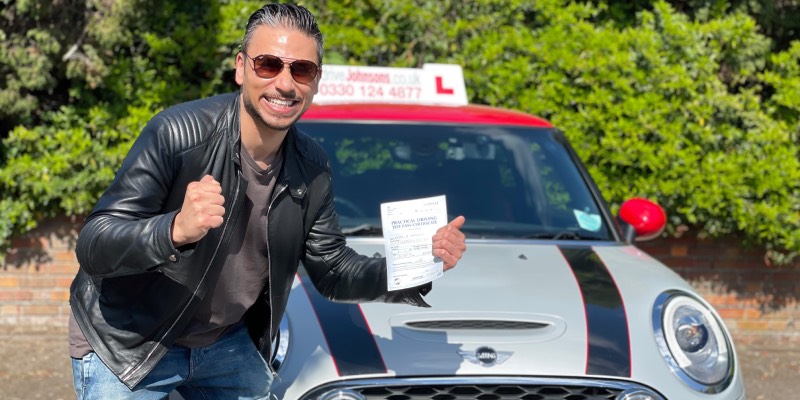
Ricky Norwood, actor on EastEnders and Celebrity Big Brother runner-up, chose to learn with driveJohnson’s. He passed first time – with class!