Wondering how many mistakes you can make on your driving test? As test day approaches, this is one of the most common questions learners think about.
The good news is that not every mistake means you’ll fail. In fact, you can make several minor faults and still pass.
In this guide, we’ll break down exactly how many mistakes you can make on your driving test, including the difference between minor and major faults, and the most common mistakes to avoid.

- Watch Ricky Norwood make mistakes on his mock test
- Is it normal to make mistakes on a driving test?
- What are minor faults in a driving test?
- What are major faults in a driving test?
- How many majors can you have on a driving test?
- How many minors can you have on a driving test?
- Common driving test mistakes
Watch Ricky Norwood make mistakes on his mock test
Actor Ricky Norwood took a mock driving test with driveJohnson’s Director, Anthony Johnson. Watch the video below to see the mistakes he made and how this affected his result.
Is it normal to make mistakes on a driving test?
Whether you are taking driving lessons in Bedford, Bournemouth, or Blantyre, your driving test is a big thing, and it is normal to make mistakes.
Driving test examiners see nervous drivers all the time on their tests and will be expecting you to have some level of anxiety. However, nerves can cause you to make silly errors, resulting in driving faults.
You can make mistakes and still pass your test. However, what could stop you from passing is the number of mistakes you make and whether these are minor or major faults.
What are minor faults in a driving test?
Minor faults (referred to as a driving fault on the test sheet) are mistakes that have little or no effect on the safety of yourself, your examiner, or other road users.
Examples of minor faults include:
- Hesitating slightly at a junction
- Not checking mirrors as early as you could have
- Slightly misjudging your positioning on the road
If you make a silly mistake, the examiner is interested in seeing how you safely deal with that mistake and rectify the situation.
For example, hitting the kerb during the parallel park manoeuvre is not ideal. Still, as long as you can safely readjust and complete the manoeuvre correctly, it would usually be classed as a minor fault. In the same scenario, if you were to adjust without checking the mirrors and there was a passing car, this would result in a dangerous fault.
What are major faults in a driving test?
In the UK driving test, major faults on your driving test are split into two categories:
- Serious faults: Mistakes that could potentially be dangerous
- Dangerous faults: Mistakes that create actual danger to you, the examiner, or other road users
Examples of major driving faults include:
- Failing to observe properly at a junction
- Poor lane discipline on a roundabout
- Not responding correctly to traffic lights or road signs
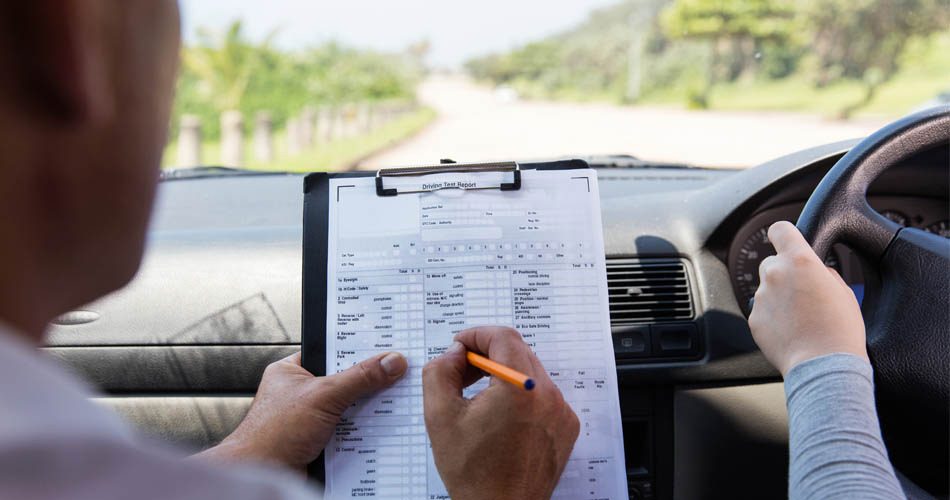
Your examiner is looking to see if you can keep yourself and others on the road safe. If you display something during the examination that leads them to believe you could be a danger to yourself or others on the road, they will mark it as a serious or dangerous fault on their marking sheet, and you will fail the test.
If the examiner is seriously concerned about your driving and believes that it is too dangerous for you to continue with your test, they can stop the test and take over. Although rare, it does happen, and if it does, it’s safe to assume you’ve failed your test.
How many majors can you have on a driving test?
To pass your driving test, you must not receive any major faults. Even if your driving is otherwise strong, just one serious or dangerous fault will immediately fail you, and usually, you won’t find out that this has happened until the end of the test.
An example of a scenario that could result in a serious or dangerous fault would be approaching a roundabout and having incorrect lane positioning. If there were no cars on the roundabout at the time of this happening, you would receive a serious fault; however, if there were other cars on the roundabout when this occurred, it would result in a dangerous fault.
The difference between a serious and a dangerous fault is that, in the case of a dangerous fault, the examiner decides that the mistake poses such an immediate danger to yourself and/or other road users that they have to take action by using their dual controls or grabbing the wheel.
In both serious and dangerous faults, the outcome is the same, and you would fail your driving test.

How many minors can you have on a driving test?
You can have up to 15 minor faults on a driving test and pass; anything more than this will result in an automatic fail. These are recorded on your test report, which you will be given at the end of the test.
You can also fail your test for having too many faults in one particular element of the driving test marking scheme, for example, in the “Use of Mirrors” section. As a general rule, if you exceed more than four minor faults in one area of the marking sheet, it becomes a serious fault, and you will fail the test.
While each individual minor fault isn’t serious, repeated mistakes of the same type can become a bigger issue because they build a picture of unsafe and unconfident driving. For example, consistently forgetting mirror checks could be marked as a more serious fault. This is why awareness, observation, and decision-making are so important during your test. It’s not about driving perfectly, but it is about demonstrating to the examiner that you can drive safely at all times.
Common driving test mistakes
While every test is different, there are some common mistakes that learners tend to make. Being aware of these can help you avoid them.
Some of the most frequent issues include:
- Not checking mirrors before changing speed or direction
- Poor observation at junctions and roundabouts
- Incorrect positioning on the road
- Hesitation that affects other road users
- Moving off unsafely or without proper checks
- Inaccurate signalling or signalling too late
Many of these come down to nerves rather than ability. That’s why our driving instructors in Luton, Liverpool, and across the UK will help you to build good habits and consistency to deal with driving test nerves.
Top tip from Andy Brown, one of our driving instructors in Oxford:
I would always recommend anyone approaching their driving test to have a few mock driving tests. It’s a great way to understand the difference between minor driving faults and serious/dangerous driving faults.
Many learners don’t realise how easy it is to make a mistake that would result in a test fail, so by doing a few mock tests, it can be great preparation and often reduce the chances of failing on the big day.
Making mistakes on your driving test: final thoughts
No matter how much you prepare for your driving test, chances are you will make mistakes during your practical test. The important thing to remember is that you are only human, and mistakes are a normal part of everyday life.
Our driving instructors at driveJohnson’s will never put you forward for your test unless they believe you display the characteristics of a safe and competent driver. So be confident, try not to panic, and do your best. And if you do fail your driving test, don’t let it discourage you. It just means you need some more practice. Take it as a positive: you can learn from your mistakes and ace the test next time.

Written by Anthony Johnson
Grade A - 51/51
ORDIT Registered Trainer