Bus lanes are a costly trap for many drivers. Although they are a regular part of our roads, the rules around when you can legally drive in a bus lane are often misunderstood.
Nearly 4,000 drivers receive a bus lane fine every day, not because they deliberately break the law, but because the rules can be unclear or easy to miss.
So, can you drive in a bus lane? Read on to find out what is legally allowed, what is not, and how you can avoid picking up an unnecessary fine.

When can you drive in a bus lane?
When and where you can drive in a bus lane depends on the signs and road markings surrounding the bus lanes. Rule 141 of the Highway Code explains that:
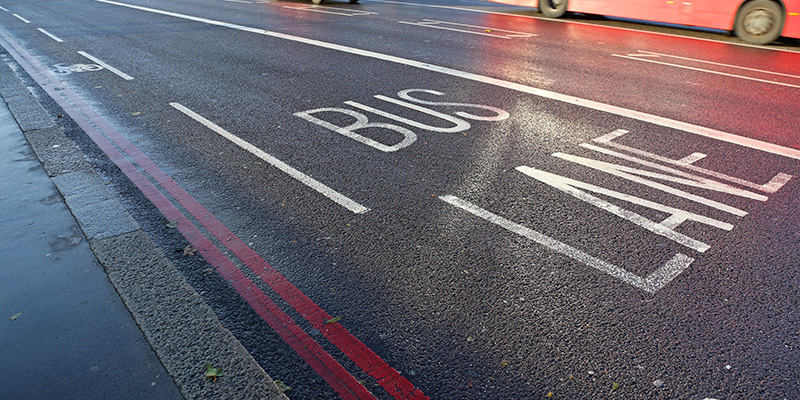
- Bus lanes will be clearly marked with road signs and road markings.
- The signs tell you which vehicles are allowed to use the bus lane and when.
- If the bus lane is in operation, you should not drive in it unless a sign says you can.
- In some places, you may briefly enter a bus lane to stop, load or unload, but only if this is clearly allowed.
You will be able to tell when you are approaching a bus stop as there will be white dashed lines, which then turn into a solid white line. The solid white line is where the bus will stop. Always look out for the signposts at the bus stop. These will tell you if you are allowed to drive through the bus stop and, if so, at which times of the day.
It is worth noting that if it is illegal to drive your car in a bus lane, you can take it as read that you are not allowed to park, wait or load in that bus lane either.
Bus lane signage
Bus lane rules can vary from town to town. For example, learners taking driving lessons in Crawley may encounter different bus lane operating hours compared to other parts of the UK, which is why checking local signage is always essential.
What does a white bus stop sign mean?
If there is a white sign that simply says “Bus Stop”, it is just advising you that there is a bus stop at that point. There are no legal rules, and you can drive here.
What does a blue bus stop sign mean?
Blue signs will show symbols of the vehicles that are allowed in the zone, the times that the bus stop is in operation and the days of the week.
Each sign will have different times and days printed on it, so always try to slow down enough when approaching to see the times clearly. For example, if the sign says “Mon-Fri, 7-10am”, it means you are not able to drive in the bus lane on weekdays between 7 am and 10 am.
Some bus signs have two times on them, which means that you can only drive outside of the times stated.
If there are no times or dates on the blue sign, it means it is always in operation. At no time can you drive on these bus lanes.
One-way roads and bus lanes
If you are driving on a one-way road, the bus lane is often on the right-hand side. If this is the case, these lanes are in operation 24 hours a day.
Why would you need to drive in a bus lane?
In some cases, you may need to briefly enter a bus lane during its operating hours. Reasons for this would include:
- To allow emergency services, such as an ambulance, through.
- If roadworks are blocking your side of the road.
- If the bus lane is next to a junction and you need to turn left, though you can be fined for changing into a bus lane too early.
Penalties
Our driving instructors in Northwich, Nuneaton and other areas often remind learners that bus lanes are one of the easiest places to pick up an unexpected fine, especially when driving on unfamiliar routes.
It has become more and more common for councils to fit CCTV around a bus stop and bus lane area; this is their main way to fine drivers. They use the cameras to take footage of all passersby and then pause and take a photo of any cars they notice disobeying the laws.
If you are caught on camera driving in a bus lane, you will be given a PCN, which is a Penalty Charge Notice.
This PCN may affect your insurance costs if your insurer considers it a risk factor when you come to renew.
Story from one of our instructors…
We spoke to Andy Sterne, who offers driving lessons in Essex, about an operation put in place by the council in his local area.
“I read an article about a reinforcement Essex County Council put in place to keep track of how many drivers used bus lanes in restricted hours, and the statistics really shocked me. In the space of just 25 days of installing CCTV cameras surrounding bus lanes, the council managed to catch 5,000 motorists breaking the law, which made them at least £300,000 in less than a month. This really proves why it is so important for both learners and experienced drivers to know the rules!”
What’s the fine for driving in a bus lane?
Councils set their own fines, which typically vary from around £60 to £180. Some councils will reduce the amount they charge if you pay quickly. You can check the gov.uk postcode tool to find your council’s PCN payment portal.
Do you get points for driving in a bus lane?
In the UK, you do not get penalty points on your driving licence just for driving in a bus lane. This is because:
- Only the police or courts issue Fixed Penalty Notices that carry points that go on a driving record.
- Bus lane enforcement is a civil traffic regulation, not a criminal driving offence.
If you break the bus lane rules, you will likely receive a fine, in the form of a PCN, not points.
Appealing a Penalty Charge Notice
If you believe that you have been unfairly or wrongly fined, you do have the option to appeal. Your Penalty Charge Notice will state exactly where the event happened, so check the photos from your PCN carefully.
Go back and check whether the bus lane has all of the correct signs. If any of the following are missing, you have the right to appeal:
- “Bus Lane” painted onto the tarmac.
- A white dashed line followed by a solid white line, separating out the bus lane from the other lanes.
- A signpost with the days and hours of operation.
You can also appeal if you were forced into the lane to avoid a hazard or follow police directions. However, to win the appeal, you must support it by providing evidence.
What if I accidentally drive in a bus lane?
Accidents happen, but if you enter a bus lane unintentionally, exit it as soon as you safely can. Many councils will still issue a PCN even if you were only in the lane for a short distance.
Being unfamiliar with a route alone doesn’t usually win an appeal, but confusing, obscured or missing signs sometimes do.

Tips for driving on or around a bus lane
Here are our top tips to keep in mind when driving on or around a bus lane:
- Always give way to a bus which is pulling off from a bus stop, unless it is in its own single lane.
- Look out for pedestrians leaving the bus when passing; they might be in a blind spot.
- If the bus lane is out of its operating hours, moving into a bus lane will allow others to overtake you.
- Only overtake a bus stopped at a bus lane if you can see a lot of passengers waiting to get on or off, and you have enough time to drive the full length of the bus without causing disruptions.
On your test, remember that failing to use a bus lane when you could have done so may result in a minor or possibly even a major fault, so always read the signs.
When can you drive in a bus lane in the UK: final thoughts
Hopefully, this article has made it clearer when you are allowed to drive in a bus lane in the UK and when you should avoid one. Bus lane fines and rules can vary depending on the area and time of day, so it’s important to keep an eye out for road signs and markings to stay ahead of any restrictions.
Many drivers feel unsure how to drive around bus lanes, but there’s no need to panic. By staying calm, following the signage and remembering the basics, you can handle bus lanes safely and with confidence.

Written by Anthony Johnson
Grade A - 51/51
ORDIT Registered Trainer