This manoeuvre often looks easier from the passenger seat than it feels behind the wheel. Reversing around a corner isn’t part of the UK driving test anymore, but it’s still one of the best ways to sharpen your control and observation skills.
Many learners find it tricky at first, but once you understand your reference points and keep your speed under control, it becomes a predictable and manageable manoeuvre. Here we break down exactly how to reverse around a corner perfectly every time.
- Is reversing around a corner still in the driving test?
- How to reverse around a corner step by step
- How to reverse round a corner – at a glance
- When reversing around a corner, where should you look?
- Do you indicate when reversing around the corner?
- Tips on reversing around a corner
- Common mistakes when reversing around a corner
Is reversing around a corner still in the driving test?
No, reversing around a corner was removed from being tested as part of the UK driving test in December 2017.
However, our driving instructors in Bedford, Birmingham and across the UK all teach it as it helps develop key driving skills. Mastering it involves using precise clutch control at low speed, accurate steering and positioning, effective all-round observation, and safe decision-making when under pressure, which are all essential for driving. The techniques you learn from reversing round a corner will help you with other manoeuvres such as parallel parking, bay parking, and general reversing.
In short, it’s no longer a test requirement, but it’s a very valuable skill for becoming a confident and safe driver.
How to reverse around a corner step by step
If you try to do everything at once, reversing around a corner can feel overwhelming. That’s why, at driveJohnson’s, our driving instructors in Huddersfield, Cardiff and elsewhere teach it in a calm, step-by-step way, helping you build control and confidence as you go.
Here are the steps they teach:
Find a safe and legal place
Make sure the road you want to reverse into doesn’t have any obstructions like parked cars, bin bags or even children playing near the kerb. Look into the road before driving past it.
Start position
Stop about three car lengths before the corner you want to reverse around and secure the car. Cancel your signal if needed, select reverse gear, and prepare to move using POM. Before you start to move backwards, carry out full 360° observations. Only start reversing when it is safe to do so.
Control
Your speed should be a very slow walking pace. Stay about a drain’s width from the kerb.

Observations when reversing
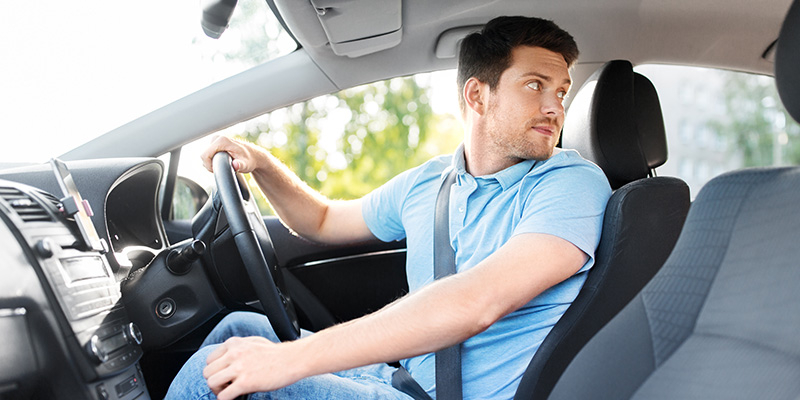
Make sure you’re looking over your left shoulder when reversing, and keep your head scanning all around you for hazards coming towards you.
Priorities
Be prepared to stop if you think your vehicle could potentially affect the speed/position of approaching vehicles. It’s their priority.
Before you turn left
You should look all around you and do 360 observations. If a vehicle is approaching, stop. It’s their priority. A good time to turn is when the bend of the kerb just disappears out of your left door mirror, but your instructor may give you a slightly more accurate focal point for their car.
Steering
As a general rule, you should turn the steering wheel 1 full turn left. Avoid dry steering. Be prepared to take some of the steering off if your vehicle becomes less than a drain width from the kerb and looks like it may hit the kerb.
When you come around the corner, remember whatever you have done to the steering wheel to the left, you will need to do the same to the right to straighten, i.e. if you have turned one full turn left, then to straighten up, you should turn 1 full turn right.
How to reverse round a corner – at a glance
- Keep speed at a walking pace or slower.
- Stay close to the kerb (about a drain width away).
- Do full 360° observations before turning.
- Begin steering when the kerb starts to disappear in your left mirror.
- Use one full turn of steering left, then reverse it to straighten.
- Stop immediately if anything feels unsafe or unclear.
- You can take a forward shunt if your position goes wrong, as demonstrated in the video below (this is fine to do in your driving test).
When reversing around a corner, where should you look?
When reversing around a corner, your main focus should be over your left shoulder, as this gives you the clearest view of the kerb and the direction you’re travelling into.
However, you should constantly be scanning your surroundings, not just staring in one direction. This means you should be checking:
- Over your left shoulder (your main reference point)
- Both mirrors to monitor your position
- All around the vehicle for any hazards or changes in traffic
Think of it as a continuous 360° awareness check, rather than focusing on just one view.
The biggest mistake learners make is focusing too much on the kerb and not enough on what is happening around them. If something changes around you, especially if you see traffic approaching or pedestrians, be prepared to stop immediately and reassess.

Do you indicate when reversing around the corner?
Yes, you should generally use a left signal when reversing into a left-hand corner. This is because it helps other road users understand what you are doing, which makes it safer for everyone.
However, indicating is only a supporting action, not the main priority. Your full attention should always be on observation and control.
It’s also important to remember:
- A signal does not give you priority.
- You must still wait for a safe gap if traffic is approaching.
- You should cancel or reassess your signal if your situation changes.
A good habit is to apply your signal early enough to give a clear warning to others, but not so early that it confuses other road users about your intentions.
Tips on reversing around a corner
If another vehicle comes up behind you when you’re reversing into the minor road, stop. If they continue to wait behind you, then unfortunately, you’ll have to return to your start position. Make sure you look all around you before you go forward again and put a left signal on to indicate you are turning left. If the vehicle is still behind you, then make sure you apply the MSM routine in good time to pull up on the left again.
If you get too close to the kerb or too far away, don’t carry on reversing. Stop and take a shunt forwards. When you take a shunt, make sure you stay on your side of the road. This is acceptable on your driving test and is better than going up the kerb or over on the wrong side of the road and possibly failing your driving test.
Common mistakes when reversing around a corner
There are a few common mistakes that can make reversing around a corner feel harder than it needs to be. Keep these in mind as you practise.
- Going too fast: Don’t rush the manoeuvre. Even slightly too much speed can make it hard to control your steering and positioning. Think walking pace or slower.
- Not doing enough observations: Learners often focus too much on the kerb and forget to check what’s happening around the vehicle. Keep your head moving and scan constantly, not occasionally.
- Steering too early or too late: This causes poor positioning and kerb issues. Use the kerb disappearing in your left mirror as your guide point (your instructor may adjust this).
- Over-correcting: Adjusting the steering too many times can make the car feel unstable. Make smooth, purposeful movements and allow the car time to respond.
- Trying to fix mistakes while still moving: This can make things worse. If you make a mistake, stop, reset, and then continue with control.

Final thoughts on how to reverse around a corner
As with many manoeuvres, reversing around a corner becomes a lot easier once you stop trying to rush it and start focusing on control. With the right support and steady practice, your confidence will build naturally, which is why our driving instructors in Sheffield, Eastbourne and across the UK support learners in a calm and structured way.
Don’t worry if it takes a while to master this manoeuvre. Most learners need a few attempts before it starts to click properly. Once it does, you’ll find your control improves not just here, but in other manoeuvres too.

Written by Anthony Johnson
Grade A - 51/51
ORDIT Registered Trainer