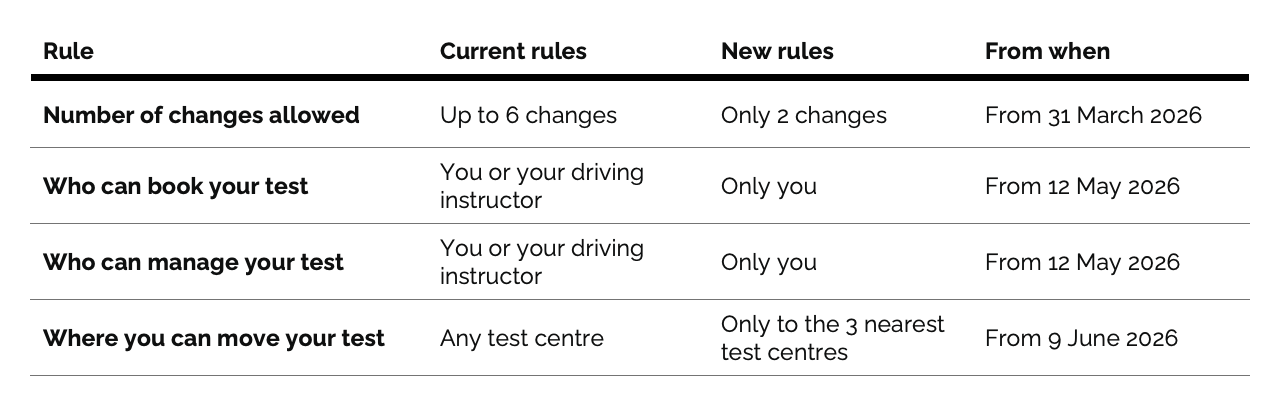
The DVSA recently announced changes to the driving test, which come into effect from 31st March.
There have been some major concerns about the changes. The driving instructor industry seems split on the plans, with many opposing and many welcoming the changes.
The one plus side to come from all of this will be that every learner trying to book a driving test will now be on an equal playing field.
Driving tests have been sold on the black market for in the region of £250-300 for many years now, leaving many learners who can’t afford those fees to try and join the back of the queue and wait 6 months. One of the biggest problems has been that even if you try to join the back of the queue and log on Monday morning at 6am, the driving tests are taken by bots, leaving learners in a queue, and when they finally can log on, the tests are all gone for their chosen town/city.

- What are the new driving test rules?
- Pros of the driving test changes
- Cons of the driving test changes
- The DVSA and government response has fallen short
- What can the DVSA do now?
- Challenges ahead for the DVSA
- How can the DVSA recover from these problems stemming from Covid-19?
- What the DVSA will likely do next
What are the new driving test rules?
The new rules for booking and managing car driving tests will be introduced from spring 2026 and they will impact learners taking driving lessons in Peterborough, Pitlochry, and all across the UK.
We asked the director of driveJohnson’s, Anthony Johnson, who is also a Grade A 51/51 registered instructor, for his insight into everything up to now, including the pros/cons.
Pros of the driving test changes
Fairer access to test slots
- Reduces bots and resellers hoarding appointments.
- More learners can book at the official price instead of paying inflated resale fees.
This is particularly relevant in high-demand areas like London, where many learners were paying in the region of £250-£300 for a test.
Potential to reduce waiting times (very long term)
- Discourages people from booking speculative slots and repeatedly changing them.
- Encourages learners to book only when they are financially ready to commit to lessons.
In theory, this should improve availability over time. Many learners currently book tests before they are ready to fund or commit to lessons. By the time they begin lessons, they may only have 1–2 weeks before their test, and their self-assessed readiness often does not align with their instructor’s judgement.
Less system abuse and fraud
- Requiring learners to manage their own bookings makes it harder for third parties to exploit the system.
- Part of a broader effort to tackle scams and black-market bookings.
Encourages better preparation
- With only two changes allowed, learners are more likely to:
- Book when genuinely ready
- Take lessons more seriously
This could improve pass rates and reduce wasted test slots.
More predictable scheduling for instructors
- New controls around availability can help instructors plan better.
- Fewer last-minute changes and clashes.
This could particularly benefit driving instructors in Slough, Edinburgh, and across the UK, who have had to manage constant last-minute changes.

Cons of the driving test changes
The core issues remain:
- Examiner shortages
- High demand
Waiting times are unlikely to significantly improve on their own. The DVSA has been attempting to recruit examiners over the past four years, but retention appears to be an issue, with examiners leaving as quickly as they are joining.
In many large towns and cities across the UK, waiting times for a driving test exceed 20 weeks (over six months). This has directly learners taking driving lessons in Oxford, Manchester, and other areas, where test availability remains extremely limited.
If the underlying capacity issues are not resolved, there is a risk that people will find new ways to exploit the system, given the strong financial incentive to secure earlier test appointments.
Increased risk of unlicensed and uninsured driving
- Some learners may resort to driving illegally if they can no longer pay to access earlier test slots.
- Those previously willing to pay £250–£300 to jump the queue may be less willing to wait extended periods.
There is a reasonable risk that removing the ability to pay for earlier tests could push a small number of impatient learners toward unlicensed and uninsured driving, particularly where waiting times remain long.
Much less flexibility for learners
- Only 2 changes total (including date, time, or test centre).
- Unexpected events (illness, work conflicts) can quickly use up the allowed changes.
This is the most common criticism.
Reduced instructor control over test management
- Instructors have less ability to manage and swap test bookings between learners.
- Previously, instructors could reallocate slots to match learners who were ready earlier or later.
Many instructors valued the flexibility of the old system, as it allowed them to optimise test timing across their pupils. This was particularly important for those focused on maintaining strong pass rates and ensuring learners were genuinely test-ready, reducing the likelihood of disappointment or failed tests.
Potential increase in aborted driving tests
- Some learners may proceed with tests despite not being fully prepared, particularly if they cannot afford additional lessons.
- Learners who have already used their allowed changes may be reluctant to give up their slot and return to the back of the queue.
- A common mindset among learners is: “I don’t mind if I fail, at least I have given it a go.”
While the changes aim to ensure learners are more test-ready, financial constraints may lead some to attempt the test prematurely. This could result in more aborted or unsafe tests, particularly if learners use vehicles without dual controls (e.g. a parent’s car or a hire car).
In some cases, the lower upfront cost of a standard test (£62) compared to previously inflated resale prices (£250–£300) may further reduce the barrier to “just giving it a go,” even when not fully prepared.

Risk of being stuck with a poor test date
With long waiting times (often 20+ weeks in some areas), learners may:
- Book early just to secure a slot
- Later discover that they are not ready
Limited changes make this harder to fix.
Potential disadvantage for some groups
People with:
- Irregular work schedules
- Health conditions
- Caring responsibilities
These groups may need more flexibility than the new system allows.
Increased pressure on learners
Each booking decision carries more weight. Mistakes (e.g. wrong test centre or timing) use up one of the limited changes.
For those juggling driving lessons in Luton, Liverpool, and across the UK alongside work, education, or family commitments, this adds stress to the process.
Possible unintended behaviours
Learners may delay booking out of fear of using their limited changes.
Some may cancel and rebook instead of rescheduling, potentially creating inefficiencies.
The DVSA and government response has fallen short
We would likely not be facing the current situation if the government and DVSA had allowed driving lessons to continue during periods when schools remained open throughout Covid-19. Instead, driving instructors were only permitted to return to work alongside sectors such as hairdressers and barbers, which were among the last to reopen.
Key issues that were not fully considered:
- A single haircut resolves immediate demand, with no long-term backlog
- Disrupted driving lessons over 12+ months created a sustained backlog of learners still needing tests
Other sectors, such as estate agents, were allowed to continue operating as early as October 2020 to support the economy, while driving instruction remained restricted.
There were also missed opportunities in forward planning:
- Limited early action to anticipate long-term demand pressures
- Examiner recruitment could have started earlier, particularly ahead of the end of furlough in September 2021
- Active recruitment only began around April 2022, during a highly competitive job market (often referred to as the “Great Resignation”), making hiring more difficult
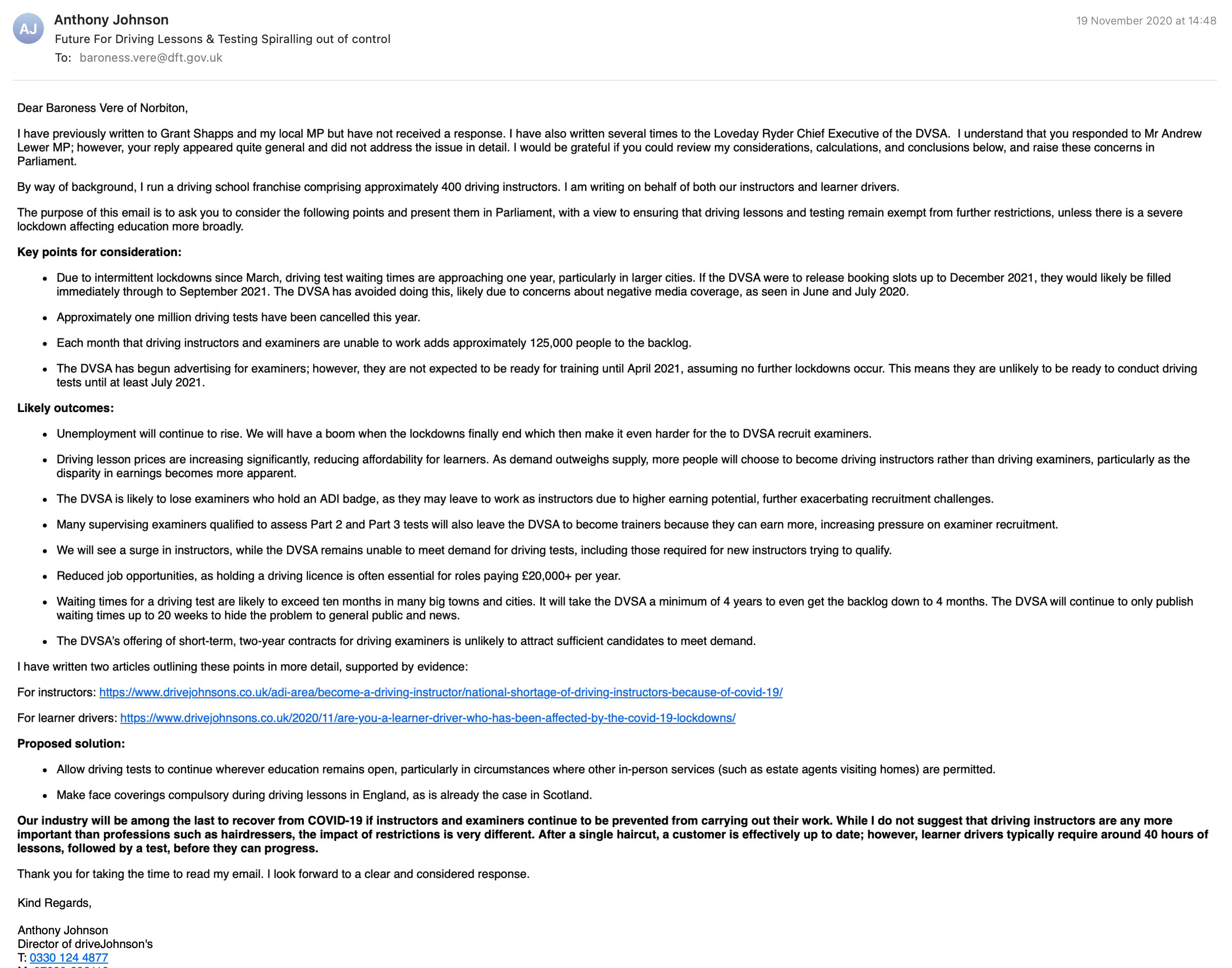
Industry concerns were raised at the time. Anthony Johnson, Director of driveJohnson’s, contacted multiple stakeholders during 2020 and 2021 to highlight the risks and potential long-term impact, but these concerns were not acted upon.
Those contacted included:
What can the DVSA do now?
We asked Anthony Johnson, the director of driveJohnson’s, what he would do if he were in charge of the DVSA…
The DVSA is currently struggling to recruit sufficient driving examiners, largely because salaries are typically in the region of £28,000–£30,000 per year.
Options:
1. Increase the driving test fee to £90 and allocate the additional £30 towards examiner salaries
- This could raise starting salaries to around £35,000 per year
- Existing examiners could receive an immediate pay rise of £2,000–£3,000
- Further incentives could increase earnings up to £35,000 for those who remain in the role for 2–3 years
A potential drawback is that, if the backlog is eventually reduced, there may be an oversupply of examiners. However, this risk is likely at least three years away.
2. Shorten the driving test to 25 minutes (from 38–40 minutes)
- Reduce the requirement for manoeuvres to 1 in 3 tests
- This could allow each examiner to conduct approximately two additional tests per day
- Introduce the change via temporary emergency legislation lasting 1–2 years
- Once waiting times reduce to around 2–3 months, revert to the standard 38–40 minute format
Option 2 is not ideal, but it may be the quickest way to address a problem that has now persisted for over five years.

Challenges ahead for the DVSA
The DVSA also faces challenges in delivering Part 2 and Part 3 tests for trainee driving instructors.
- Waiting times to become a driving instructor for Part 2 and Part 3 tests are approximately 6 months, significantly slowing the qualification process.
- Trainees have a 2-year window to fully qualify as an ADI (Approved Driving Instructor), which starts on the date they pass the Part 1 theory test.
- Only one trainee licence is typically granted to PDIs (Potential Driving Instructors), and obtaining a second licence can be difficult.
This creates a difficult situation for many PDIs. The timelines often do not align, meaning trainees can run out of time despite investing thousands of pounds in training. As a result, some leave the industry without a fair opportunity to qualify and thousands of pounds out of pocket.
Typical scenario:
- PDI passes Part 1 (theory test) on 1 January 2025
- PDI books Part 2 (driving ability) on 2 January 2025
- DVSA schedules Part 2 for 15 June 2025
- PDI fails and rebooks on 16 June 2025
- DVSA schedules second attempt for 30 December 2025
- PDI passes Part 2
- PDI completes 40 hours of training (typically around 2 months for quality training, though it can be done intensively in 1 week)
- Training completed by 1 March 2026
- PDI applies for their first trainee licence starting 16 March 2026
- PDI must complete a further 20 hours of training within 3 months before booking Part 3
- PDI books Part 3 on 16 May 2026
- DVSA schedules Part 3 for 1 October 2026
- PDI fails first attempt and rebooks on 2 October 2026
- DVSA schedules second attempt for 2 March 2027
- PDI’s 2-year qualification period ends on 1 January 2027
At this point:
- The second attempt effectively becomes the final attempt
- The PDI cannot book a third attempt if they fail
- This creates significant and arguably unnecessary pressure, despite the trainee being proactive throughout
Additional considerations:
- If a PDI fails the Part 2 twice, they may only have one attempt remaining at the Part 3
- Any break in training (even short periods such as school holidays of around 6 weeks) can further reduce the number of realistic attempts available within the 2-year window
How can the DVSA recover from these problems stemming from Covid-19?
In an ideal scenario, the DVSA could be sold to a private investor, allowing changes to be implemented more quickly. This could include increasing test fees more easily, improving examiner pay, and introducing broader operational reforms. The DVSA was reportedly considering this approach prior to Covid-19.
However, such a move would likely face significant challenges. Employees may prefer to remain as civil servants, and any shift towards privatisation could result in resistance from staff and unions. This could lead to industrial action.
Between 2022 and 2024, many examiners took strike action in response to proposed changes to their working conditions. These disruptions further contributed to the existing backlog of driving tests and PDI testing.
With this in mind, there would likely be internal challenges within the DVSA, which, as seen previously, could create further chaos and additional backlogs.
What the DVSA will likely do next
In January 2026, the DVSA launched a new consultation exploring several potential changes:
Minimum learning period
There could be a required time gap for learners between passing the theory test and taking the practical test. For example, learners may need to wait a set number of months before booking a test.
Currently, learners can take the practical test immediately after passing the theory test.
Minimum learning hours
There could be a possible requirement for a set number of supervised driving hours.
This could include:
- Lessons with a qualified instructor
- Practice with an approved supervisor (e.g. a parent or guardian)
A structured learning syllabus
There could be an introduction of a standardised curriculum that all learners must follow.
This would potentially be similar to systems used in other countries, requiring:
- Completion of specific skills or modules
- Logged progress before becoming eligible for the test
How learning is verified
The consultation also considers:
- Who signs off completed hours
- How to prevent falsified experience
- Whether digital logbooks or instructor verification should be required
The future of driving tests: final thoughts
With the consultation running until 11 May 2026, this is likely to form the DVSA’s next course of action. However, it may also lead to further dissatisfaction among learner drivers, particularly if it introduces additional barriers to taking the test.
While the intention behind these changes is to create a fairer and more structured system, ultimately, much will depend on how they are implemented. For both learners and instructors, the coming months will be crucial in shaping what the future of learning to drive in the UK looks like.

Written by Anthony Johnson
Grade A - 51/51
ORDIT Registered Trainer