On this page
Objectives: You should be able to identify a junction with a major road ahead using the MSPSL routine on the approach. You should be able to emerge left and right from a minor into a major road, under control and with due regard and safety for other road users.
If you’ve ever asked yourself, “How do I emerge at a T-junction without panicking or holding everyone up?” you’re not alone. T-junctions are one of the first real decision-making moments learners face on the road. They test your observation, timing, and confidence all at once.
The good news is that emerging at a T-junction isn’t about luck or bravery. It’s about knowing what to expect and applying a clear, repeatable routine every time.
In this guide, we explain everything you need to know about T-Junctions and break down the process for emerging at them so you can ace it every time.
Quick Steps: How to Emerge at a T-Junction
For learners who want a simple reference before drilling down into the details, here is a quick step-by-step guide to emerging at a T-Junction that you can follow:
- Check your rear and side mirrors for traffic behind.
- Indicate clearly to other road users which way you intend to turn.
- Align your car correctly: left of the lane for a left turn, slightly right for a right turn.
- Slow down as you approach and be ready to stop.
- Look right, left, and then right again. Only move when there’s a safe gap.
- At blind junctions, move slowly to improve your view before emerging onto the other road.
What Is a T-Junction?
A T-junction is a road junction where one road ends and meets another road. The road you are travelling on comes to an end, and you must either turn left or right to join the main road.
Unlike with crossroads, you cannot drive straight ahead. This means you will need to emerge onto another road. When you do this, you must give priority to the traffic already travelling on it.
If you are learning with our driving instructors in Oldham, Glasgow, or anywhere else in the UK, we will ensure that you get a lot of practice tackling T-Junctions so that you feel fully confident with them.
Watch a Real-Life Driving Lesson on Turning Left and Right From Major Roads Into Minor Roads, Including T-Junctions
What Does a T-Junction Look Like?
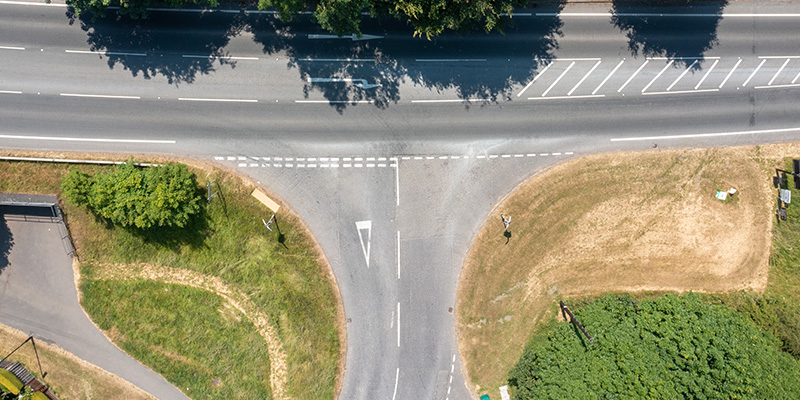
A T-junction looks exactly how it sounds, where one road meets another at a 90-degree angle, forming the shape of the letter “T”.
In the UK, as you approach a T-Junction, you may notice:
- A give way line across your lane
- A give way sign
- Road markings showing who has priority
- A stop line instead of a give-way line in areas where it is busy or your view is restricted
The main road continues across in front of you, while your road ends. Spotting these clues early helps you prepare in good time rather than reacting late.
What Does a T-Junction Sign Look Like?
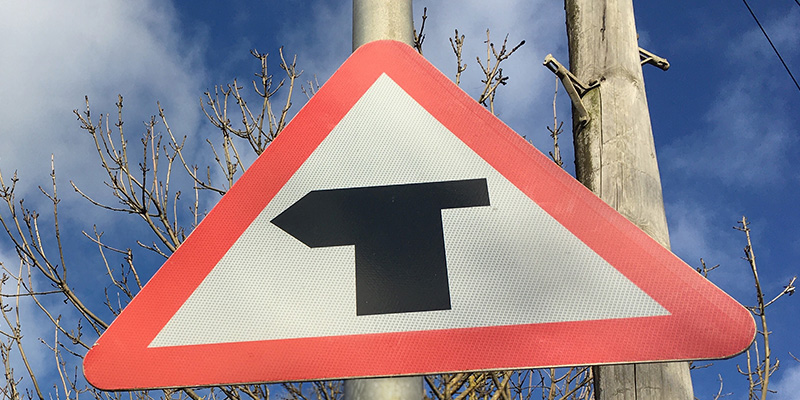
The T-Junction traffic sign is a red triangle with a black “T” symbol inside. You may see slight variations of this warning sign depending on which direction the main road bends. For example, the sign below warns that a T-Junction is coming up where you have priority over vehicles coming from the right.
A T-Junction sign indicates that the road ahead ends by joining a main road. When you see this sign, know that you should reduce your speed, check your mirrors, and prepare to give way safely.
Blind or Closed T-Junction Meaning
A blind junction (also known as a closed T-Junction) is one where your view of approaching traffic is restricted. This could be due to:
- Parked cars
- Hedges or trees
- Buildings close to the road
- Bends in the main road
At a blind T-junction, you cannot rely on a quick glance. You may need to edge forward slowly while continuing to do full observations to improve your view.
The Difference Between Closed and Open T-Junctions
There are two types of T-Junctions:
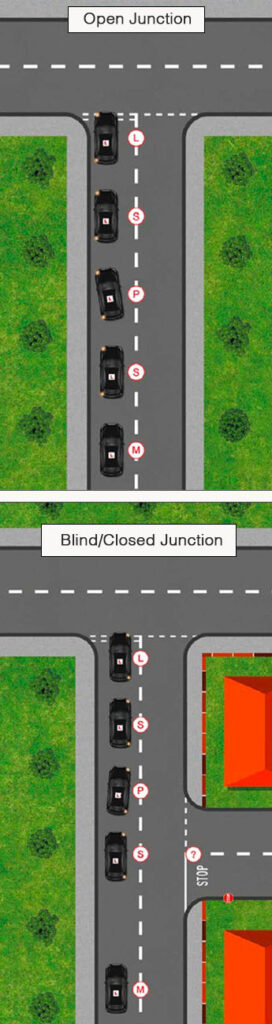
- Open: Here, visibility on the approach is good. You can see up and down the major road fully, so you will be able to make your decision earlier to go or prepare to hold back.
- Closed/blind: Visibility on the approach is usually poor due to houses, trees, etc, which block your view until you get close to the give-way line. You will therefore need to deal with closed/blind T-Junctions at a slower pace than with the open T-Junctions.
Emerging at T-Junctions Using MSPSL
The safest way to emerge is by following a routine called MSPSL:
Mirrors → Signal → Position → Speed → Look
When approaching a T-Junction, look out for the give way lines, cars turning into your road and road signs, then apply the MSPSL routine as follows:
- Mirrors: Check your interior and side mirrors, depending on which way you are planning to turn, to see where any other traffic or hazards may be. Look out for anything following close behind and emerging alongside when you slow down, like cyclists.
- Signal: Make sure you signal in good time so it benefits other road users. Be careful of signalling before the road you actually want.
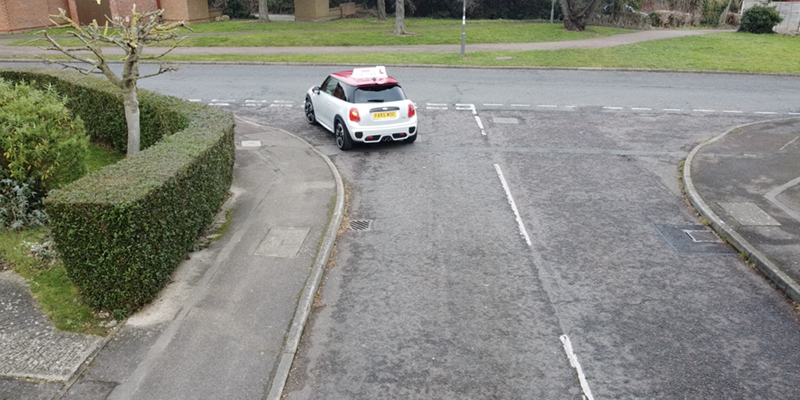
- Position: For turning left, if you’re driving on quite a wide road, then adjust your position to the left, about 1-2 drain widths from the kerb. If you’re on a narrow road, then maintain your normal driving position. If you are turning right, then position yourself beside the white centre lines but not over.
- Speed:
- Open: Reduce speed down to roughly 10mph. In manual cars, select 2nd gear and bring the clutch back up if you think you are ready to emerge.
- Blind: You will need to reduce your speed gradually. Once you are roughly 2 cars away from the give way line, then push the clutch down fully and select 1st gear. If the car begins to judder before you get to 2 cars away, then push the clutch down. Continue to brake and, again 2 car lengths away, select 1st gear ready to pull away. You may need to use clutch control to move the car forward slightly to improve your view.
- Look: The minimum observations required are to look right, left, right, before you emerge. More observations may be done if necessary, though. Think tennis match observations, and you shouldn’t go far wrong. If your view is restricted, then you can also lean forward to increase visibility. Avoid staring, quick head movements both ways. Look out for pedestrians around the T-Junction in case they step out. You will need to wait behind your give-way lines until it is clear. Cyclists are also easily missed, especially when there are lots of obstructions such as parked cars near the junction.
Choosing a Safe Gap
One of the biggest challenges at a T-junction is judging when it’s safe to go. How easy it is to find a gap that you can safely drive into will depend on:
- The speed of approaching traffic
- The road conditions where you are
- The type of vehicle you’re driving
- Whether the junction is open or closed
If you’re unsure if you have enough space to safely emerge, always wait. Emerging into a gap that’s too small can cause serious danger to both you and others. It’s wiser to be cautious than risk an accident.
Common Mistakes at T-Junctions
Even experienced drivers make errors. Avoid these common pitfalls:
- Not looking properly: A quick glance isn’t enough. Always ensure that you check right, left, right again before emerging.
- Rushing to take a gap: Never feel pressured by traffic behind. Only enter the main road only when it’s safe to do so.
- Stopping too early: Stopping too far back can make it difficult to see the approaching traffic. Edge forward slowly and carefully if needed.
- Poor positioning: Sitting too far from the centre when turning right, or drifting away from the kerb when turning left, will make it less safe and harder to see for you and other road users.
- Forgetting observations after stopping: Traffic conditions can change quickly, so always do your full observations again before moving.
Tips on How to Navigate T-Junctions Confidently
- Try to work out early on if you’re approaching an open or closed T-Junction.
- Apply the MSPSL routine in good time.
- If you are unsure of what gear you are in, touch the gear lever early.
- If you’re approaching a blind T-Junction, try not to force it into 1st gear until your speed is less than 5mph and you’re almost at the give-way line.
- You may need to use clutch control to “creep” forwards. If the vehicle moves too quickly on the clutch, dip the clutch and brake to slow it down.
Top Tips for Your Driving Test
Some areas have some really blind T-Junctions on bends. If you are taking your driving lessons in London, your driveJohnson’s instructor will most likely show you these.
The best way to deal with T-Junctions on a bend is by leaning forward. Sometimes, you need to almost look back over your shoulder to see the whole road if you’re on a bend. If it is a blind junction, take your time and creep out of these T-Junctions nice and slowly at 1mph. You may hear traffic before you see it. If you do, slow down or stop to double-check what might be there!
Key Takeaways on How to Emerge From T-Junctions Safely
Everyone starts unsure at T-Junctions. The first few times can feel overwhelming, judging gaps, scanning traffic, and deciding when it’s safe to move. However, with the right guidance and practice, they will become second nature.
Whether you are taking driving lessons in Northampton, Norwich, or Newcastle, our driving instructors will help you become a confident driver. You’ll learn how to read the road, apply safe routines like MSPSL, and make safe decisions every time you approach a junction. With our support, you’ll gain the skills you need so that you can conquer any T-Junction, no matter where you are in the UK.

Grade A - 51/51
ORDIT Registered Trainer