One question we’re often asked by learners is whether they can take their driving test in their own car, especially if they’ve been getting extra practice outside of their driving lessons.
The answer is yes. You can use your own car for your driving test, provided it meets the DVSA’s requirements. In this guide, we’ll explain everything you need to know, the checks you’ll need to make before test day, and if you’re still undecided, you can use our decision helper to help you choose the option that’s right for you.
- Can You Take a Driving Test in Your Own Car? The Rules
- Download Your Free Pre-Driving Test Checklist
- What Car Can I Use for My Driving Test?
- What Cars Are Not Allowed for the Driving Test?
- Will I Have to Take Someone With Me to My Driving Test?
- Can You Hire a Car for the Driving Test?
- Common Mistakes When Taking Your Own Car to the Driving Test
- Taking Your Own Car vs Your Instructor’s Car
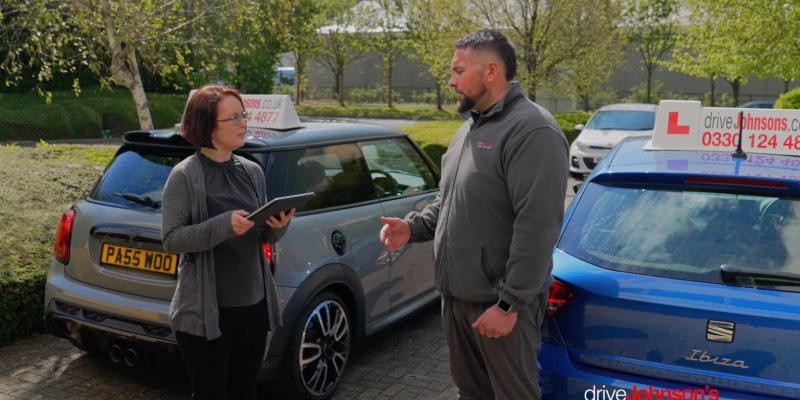
Can You Take a Driving Test in Your Own Car? The Rules
Before you can use your own car for your driving test, you’ll need to make sure it meets all of the DVSA’s requirements. Below is a quick overview of what you’ll need before test day.
Before your driving test, your car must:
- Be insured for your driving test and for driving to and from the test centre. It’s worth checking with your insurer that your policy covers both.
- Be taxed (if required).
- Have a valid MOT if it’s more than three years old.
- Be roadworthy and in a safe condition, including tyres that meet the legal requirements and aren’t damaged.
- Be able to reach at least 62 mph (100 km/h).
- Have a mph speedometer (either alone or alongside km/h).
- Have 4 wheels and a maximum authorised mass (MAM) of no more than 3,500 kg.
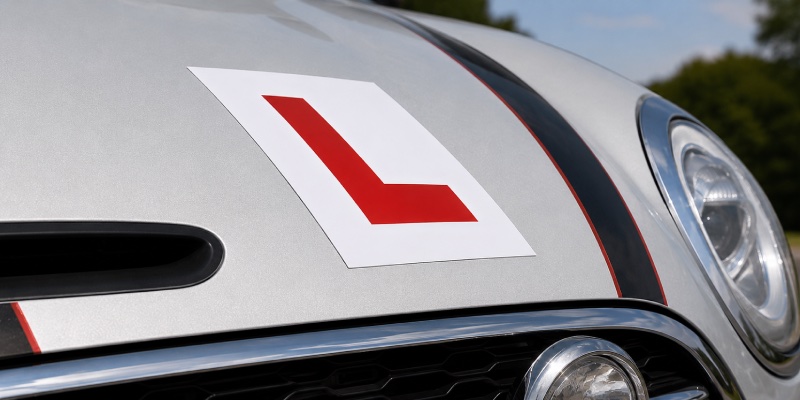
- Display L plates (or D plates in Wales) on the front and rear of the vehicle.
- Have an additional interior rear-view mirror fitted for the examiner.
- Have a working passenger seatbelt and a suitable passenger head restraint for the examiner.
- Be smoke-free. You must not smoke in the car before or during your driving test.
- Have no warning lights showing, such as the airbag or engine management warning light.
- Be clean enough for the examiner to carry out the test safely.
- Not be one of the DVSA’s prohibited vehicles. We’ll explain which cars aren’t allowed later in this guide.
Most learners won’t have any problems meeting these requirements, but it’s worth taking a few minutes to check everything before test day. If you don’t already have one, you’ll also need to purchase an additional interior rear-view mirror for your examiner before your driving test. That way, you can arrive at the test centre knowing both you and your car are ready.
Download Your Free Pre-Driving Test Checklist
Everything in One Handy Checklist
If you’re taking your driving test in your own car, download our free Pre-Driving Test Checklist to help make sure you’ve not overlooked anything before test day.
Download Your Free Pre-Driving Test Checklist Click here to download and print your Pre-Driving Test Checklist.
What Car Can I Use for My Driving Test?
As long as your chosen vehicle meets the requirements we’ve covered above, most makes and models are perfectly suitable for the driving test, including SUVs and most four-seater sports cars.
Some convertibles are suitable too, particularly hard-top models with good rear visibility. If you’re thinking about taking your driving test in a convertible, we’d always recommend checking with the DVSA first, as some models may not be accepted.
One of our driving instructors in Peterborough teaches in an Audi A3 Convertible, which has been accepted by the DVSA for many driving tests. However, because suitability depends on the specific vehicle, we’d still recommend checking in advance if you’re unsure whether your own car is suitable.
If you’re in any doubt about whether your car is suitable, don’t leave it until the last minute. Get in touch with the DVSA in plenty of time before your driving test so you have time to receive a response. You can email them at customerservices@dvsa.gov.uk or call them on 0300 200 1122. If you’re contacting them by email, remember they’re incredibly busy, so you may not receive a response within 24–48 hours.
What Cars Are Not Allowed for the Driving Test?
Although most standard cars are suitable for the driving test, there are some vehicles that the DVSA doesn’t allow. These are generally vehicles that don’t provide the examiner with good all-round visibility or aren’t considered suitable for the practical driving test. If your car doesn’t meet the requirements when you arrive at the test centre, your driving test won’t go ahead and you’ll lose your test fee.
The following vehicles cannot be used for your driving test:
- Any panel van (cars without rear seats or rear side windows)
- BMW 218 Convertible
- BMW Mini Convertible
- Ford KA Convertible
- Polestar 4
- Polestar 5
- Smart Fortwo (2-door)
- Toyota iQ
- Volkswagen Beetle Convertible
There are also a few additional restrictions to be aware of. Some vehicles can’t be used for the driving test unless you can provide proof that any known safety faults have been repaired or that the vehicle wasn’t affected by a recall. Take a look at the table below to see which vehicles this applies to and the evidence you’ll need to provide.
| Vehicle Model | Recall Reason | Vehicles Affected | Recall Issue Date |
|---|---|---|---|
| Citroen C3 | Airbag | Built 2009–2016 | 20th June 2025 |
| Citroen C4 | Airbag | Built 2nd February 2010 – 20th May 2018 | 7th August 2025 |
| Citroen DS3 | Airbag | Built 2009–2016 | 20th June 2025 |
| Citroen DS4 | Airbag | Built 2nd February 2010 – 20th May 2018 | 7th August 2025 |
| Citroen DS5 | Airbag | Built 2nd February 2010 – 20th May 2018 | 7th August 2025 |
| DS Automobiles DS3 | Airbag | Some vehicles built 2016–2019 | 20th June 2025 |
The information in this table was accurate when last reviewed in July 2026. If you’re taking your driving test in the future, it’s worth checking the latest DVSA guidance before test day.
If your car has driver assistance features, such as self-parking or Tesla Autopilot, you can still use it for your driving test. However, these features must not be used during the test.
Finally, you won’t be allowed to use a vehicle with a camera or audio recording device fitted inside the car. External devices, such as dash cams that only record the road ahead, are allowed.
Most learners won’t need to worry about any of these restrictions, but if your vehicle falls into one of the categories above, it’s always worth checking with the DVSA before your driving test to avoid any surprises.
Will I Have to Take Someone With Me to My Driving Test?
Yes, you must be accompanied by an adult who is at least 21 years old, holds a valid UK driving licence and has at least three years’ driving experience. If you’re taking your driving test in your own car, this could be your driving instructor, a family member or a friend, as long as they meet the legal requirements.
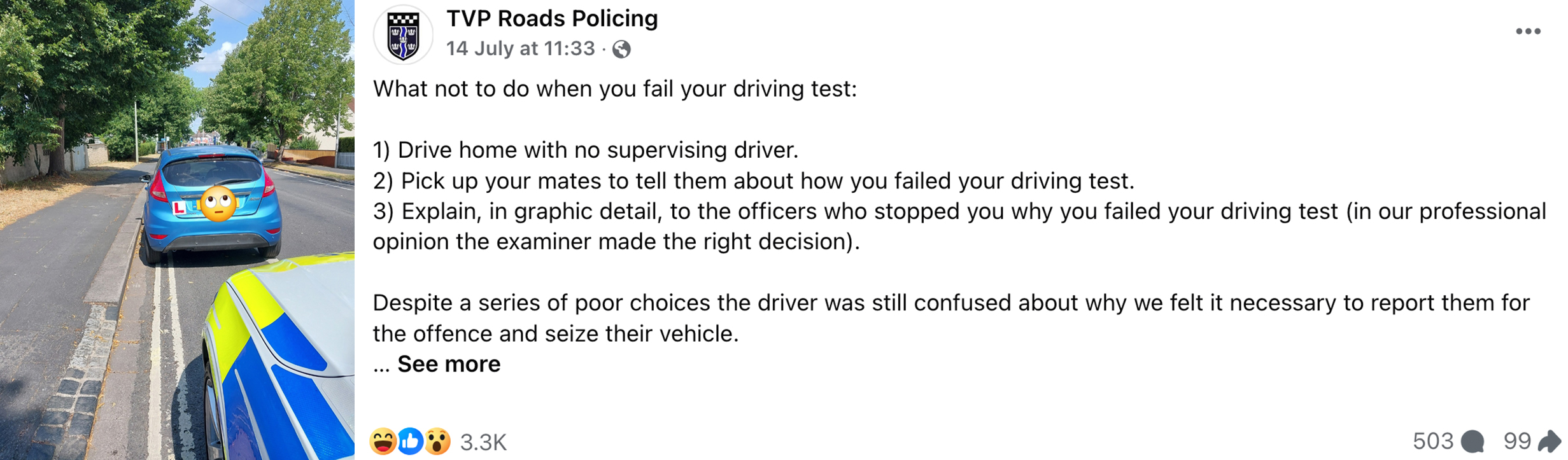
You must not drive to the test centre on your own without supervision. If you do, you risk the examiner reporting you to the police, regardless of whether you pass your driving test. The typical penalty is up to six penalty points and a fine of up to £1,000.
If your instructor isn’t taking you to your driving test, don’t automatically assume it’s for the wrong reasons. There are many right and wrong reasons why an instructor may not want to take you for your driving test. If they’re genuinely unavailable but agree you’re ready, you’ll simply need to make alternative arrangements with someone who meets the legal requirements.
Check out the news alert below from Thames Valley Police about a learner driver whose car was seized after driving without the correct supervision and insurance following a failed driving test.
Can You Hire a Car for the Driving Test?
Yes, you can hire a car for your driving test, provided it’s fitted with dual controls and meets the DVSA’s guidelines. Before booking, always check with the hire company that the vehicle can be used for a practical driving test.
It’s also important to check the insurance. Many hire companies provide insurance for experienced drivers, but not all policies cover learner drivers or practical driving tests. Always let the hire company know that you’ll be using the vehicle for your driving test so they can confirm you’re fully covered.
Arnold Clark is one of the companies that offers dual-controlled hire cars for practical driving tests, with prices starting from as little as £18 per hour. To find out more, you can take a look at the information on Arnold Clark’s website.

Common Mistakes When Taking Your Own Car to the Driving Test
Often, when taking your own car for your driving test, it’s the small details that get overlooked. Before you head to the test centre, make sure you’ve checked everything carefully. Here are some of the most common mistakes we see learners make.
- Putting your L plates in the wrong place: If your car doesn’t have a metal bumper or boot lid for magnetic L plates, it can be tempting to stick one in the rear window instead. Just make sure they don’t block your view or the examiner’s view through the rear window, as this could affect safety.
- Assuming your L plates will be good enough: If you’ve bought inexpensive L plates online, don’t assume they’ll stay attached. It’s worth fitting them before your driving test and taking the car for a short drive to make sure they stay securely in place. The last thing you want is an L plate coming loose on the way to the test centre.
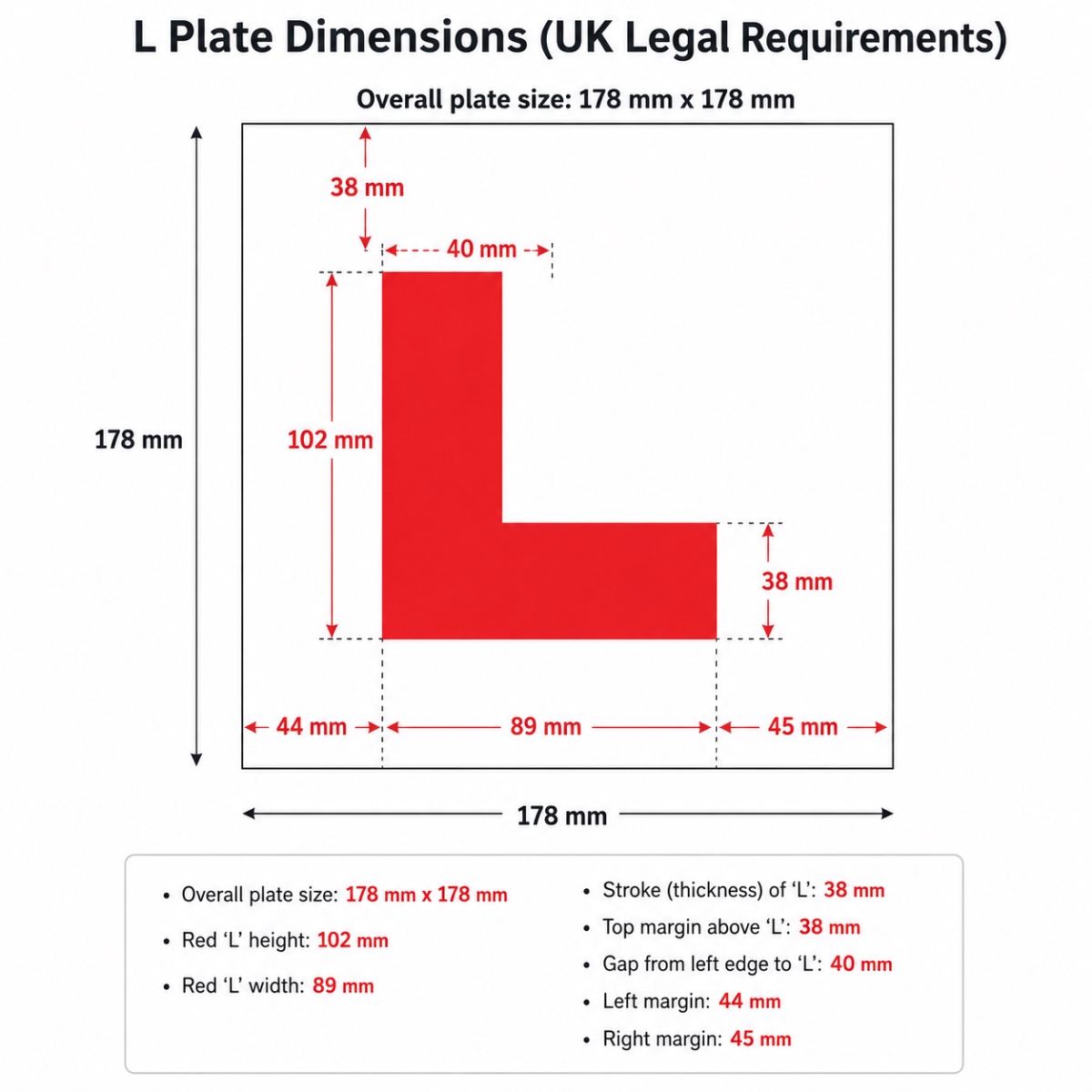
- Not checking your L plates are legal: L plates must display a red ‘L’ on a white background and be the correct size. Take a look at the image below for the exact dimensions.
- Forgetting to check your private number plates: If your car has personalised number plates, make sure the font, spacing and overall design comply with UK legal requirements. It’s an easy thing to overlook, especially if you’ve had the plates fitted for a while.
- Taking your own sat nav: You don’t need to bring one with you. If you’re asked to complete the independent driving section of your driving test using a sat nav, the examiner will provide one.
- Not checking what happens to your insurance if you pass: Some learner insurance policies end as soon as you pass, while instructor policies often cover learners with a provisional licence but not newly qualified drivers. Every policy is different, so it’s worth finding out exactly what your insurer covers before your driving test.
- Not checking the rules if you’re using an international driving licence: If you’re learning to drive or taking your practical driving test in the UK, make sure you understand which licence you’re driving under and whether you need to be accompanied. If you’re unsure, it’s worth confirming whether you can use your international driving licence in the UK before your driving test.
Taking Your Own Car vs Your Instructor’s Car
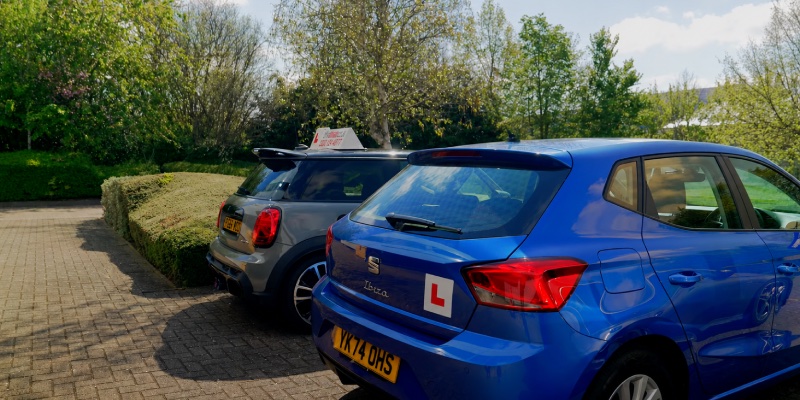
Both options have their benefits, and the right choice will often come down to which vehicle you’re most familiar with. If you’ve spent most of your time learning in your instructor’s car, you’ll probably feel more comfortable using that on test day. Equally, if you’ve had plenty of practice in your own car and know the controls well, that may be the better option for you. Below, we’ve outlined some of the key benefits of each so you can make the choice that’s right for you.
Your Instructor’s Car
- Dual controls provide an additional layer of safety and reassurance.
- Your instructor’s car should already meet all of the DVSA’s driving test requirements.
- You’ll probably already be familiar with the controls if you’ve been learning in your instructor’s car.
- Your instructor can usually provide reassurance before the test and, if needed, drive you home afterwards.
Your Own Car
- Ideal if you’ve spent plenty of time practising in your own car and know the controls well.
- You won’t need to arrange the use of your instructor’s car or rely on their availability.
- A good option if you’ve been learning with a family member or friend rather than an instructor.
- You won’t need to transfer your driving skills to a different vehicle just before your test.
Whether you choose your own car or your instructor’s, the most important thing is that you feel confident and ready on test day. For some learners, that’s the reassurance of driving their instructor’s car with dual controls and a vehicle that’s already set up for the test. For others, it’s the familiarity of taking the test in their own car. There isn’t a right or wrong choice – it’s about deciding which option is going to help you drive at your best.
Making the Right Choice for Your Driving Test
Choosing whether to take your driving test in your own car or your instructor’s car is an important decision. Think about which vehicle you’ve had the most practice in, particularly when it comes to manoeuvres and clutch control (if you’re learning in a manual car). That’s often the car you’ll feel most comfortable and prepared to drive on test day.
If you’re still undecided, our quick decision helper can help you weigh up the pros and cons of each option and decide which is likely to suit you best.
Good luck with your driving test!
Quick decision helper
Which car should you use for your driving test?
Answer five quick questions to see whether your own car or your instructor’s car may suit you better on test day.