Forward bay parking is the go-to style of parking for many drivers, often because driving forward into a bay can seem the simplest way to park. And yet, if you don’t get the technique right, this straightforward manoeuvre can suddenly become a whole lot trickier, especially in tight or crowded carparks.
In this guide, we look at the advantages and disadvantages of forward bay parking, step-by-step techniques for parking forward well, along with a few easy tips to help you pull in with confidence every time.
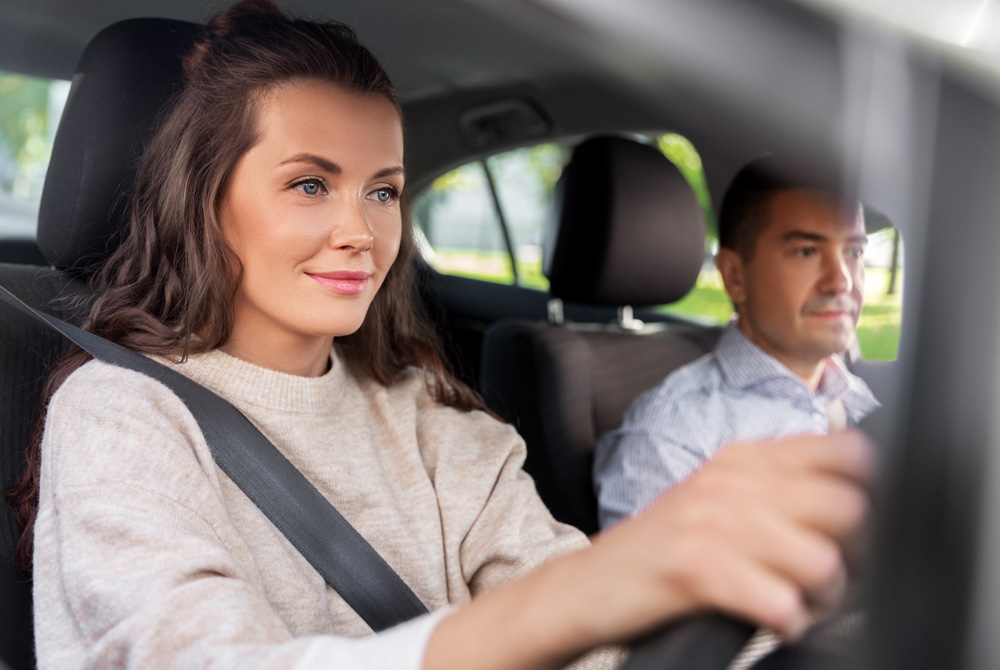
Why would you want to drive forward into a parking bay?
There are several reasons driving forward into a bay might be preferable, including the following:
- It can feel easier: Many drivers find it quicker and simpler to drive straight into a bay rather than reverse into it.
- Improved visibility as you go into the space: When you drive into the space, it can be easier than reversing to see the surrounding hazards, especially if your car doesn’t have a reversing camera.
- It can feel faster and more efficient: In some situations, you might want to park as quickly as possible. If there is traffic behind you, for example, driving straight into a space can seem faster, and it avoids making people wait while you reverse.
- It allows space to get into your car boot: When parking in supermarket car parks, having the back of your car at the entrance to the bay gives you more space to access the boot to put in your shopping. In the diagrams shown later on, pulling your shopping trolley onto the grass would be difficult.
Downsides of driving into a bay forward
Of course, while it’s easy going in, reversing out can be a bit trickier. The downsides to driving forward into a parking bay are:
- Decreased visibility as you leave the space: If you drive forward into the bay, you will need to reverse out, which means your view will likely be blocked by neighbouring vehicles, reducing your ability to see any hazards, such as pedestrians.
- Less safe: When you leave the space, you will often have to reverse out slowly, edging out until you can see, which is riskier. Reversing out into moving traffic is always less safe than reversing into an empty bay.
- Harder to be precise: It’s easier to fit into a tighter space when reversing backwards into the bay than forwards. This is because it’s generally easier to judge and gauge the white parking bay lines using the door mirrors, avoiding under-steering or over-steering, when reversing. If you are reversing into a parking bay, you can often use the parking bays in front of you to help you line your car up safely, too.
Driving into a bay forward on your driving test
Despite it being riskier to drive forward into a bay than reverse in, it is a manoeuvre that is used daily, especially in car parks where people are in a rush. It’s a key skill our instructors teach, whether you’re taking driving lessons in Birmingham or learning in a quieter part of the country, because it’s a core part of safe, confident driving. The DVSA recognise its importance too, which is why it now forms part of the driving test.
What the DVSA expect you to do on your test
Watch the short video below for an insight into what to expect on the day of your test from the DVSA driving examiner. The examiner will not tell you which bay to park in, and you can choose a bay on the left or right-hand side, if they are available.
How to forward bay park
Forward bay parking can feel a bit tricky at first; however, once you understand and practice the method, it will become a simple, repeatable manoeuvre.
We have set out the process clearly below, breaking it down into stages with numbered steps, so that you will be able to build solid parking skills for your test and future driving.
Approaching and selecting your chosen parking bay
- The moment the examiner asks you to perform the manoeuvre, check your mirrors and come off the gas pedal. You need time to select a suitable bay.
- Apply the beginning of the LADA routine (Look, Assess, Decide, then Act).
- Look out for hazards, including other cars coming into or leaving the car park, pedestrians crossing your path, or posts near the bay you are aiming for. As you are about to enter a parking bay, oncoming vehicles driving through the car park would assume priority; wait for them to pass before entering the bay.
- Some people prefer to park in a bay with cars beside them, using the cars in both bays to judge and fit into their target bay. If it’s your driving test, we would recommend (if possible) parking forward into a bay with no cars beside you. This allows you more margin for error. Remember, you can cross the white lines of the bay slightly, if it is safe to do so.
- If possible, it might be easier to choose a bay on the right side. This is because, approaching from the left side, you won’t need to go onto the other side of the road to do the manoeuvre.
- If you do choose a bay on the left, then you will need to look ahead in plenty of time. Make sure it’s safe to approach the bay on the wrong side of the road temporarily, so you can angle your car correctly and manoeuvre into the bay.
- Once you have selected your target bay, proceed to do the MSPSL routine on the approach.

MSPSL on the approach to parking forward into a bay
- Recheck your mirrors (both the interior mirror and door mirrors), so you know what’s behind you.
- If someone is behind you, then consider putting on a signal so that the road users behind and potentially in front understand that you are about to change direction.
- As you can see in the diagrams, if your target bay is on the right, then hold your position. If you have some extra space on your left side, position the car more to the left. The more space away from the target parking bay you allow, the easier it will be to finish with the car in a straight line on the first attempt.
- Once you have your position, adjust your speed to a very slow walking pace so that you can judge your steering better and stop in time if a hazard pops up.
- Keep looking around the whole time: kids can run out into the road, other road users may try to get into the bay you have chosen, and other hazards can appear.

Lining up your mirror to enter your target bay
- Your instructor may have a focal point for you, but the most common focal point is using your door mirror. Get ready to turn right when your door mirror is just in line with the first white line of the bay you want to drive into. Aim to pass the white line by a maximum of 1 foot, then start steering full lock to the right whilst the car is moving slowly.
- Initially, your front passenger side will be heading towards the red circle you see in the diagram below. If you have turned at the right time, your car should come around so that you marginally cross the edge of the bay. Imagine there is a car parked correctly in the bay on the left of your target: there would still be a small amount of room for your vehicle to go slightly over the bay and not hit the car.
- If you have mis-timed your turn and you are crossing the bay too much (i.e. you could hit a parked car if it were there), then always stop. You are allowed to reverse backwards and then drive forwards into your target bay, making the necessary adjustments to your position. This is known as a shunt. You can usually take 2-3 shunts before the driving examiner may ask you to dismiss the manoeuvre and continue with the rest of the test. If the examiner intervenes verbally or physically, then you have failed that part of your test.

When to straighten up, forward bay parking
Look at the diagram below. If you straighten up immediately based on the angle in the diagram, you may end up leaving your car at a slight angle and require a shunt.
As the car comes round into the position you see in the diagram, you will need to take the full lock of the steering wheel gradually. You will usually need to straighten the wheels completely once the car is in the bay fully and just before you come to a stop. Keep your vehicle speed as slow as possible when straightening your wheels. If you have done the manoeuvre correctly and accurately, you will be left with little space in front of you to straighten your wheels. Always try to avoid dry steering.

How to check you are straight
Look in both of your door mirrors, and you should be able to see the bay behind you. In a car park like the one in the diagram below, you could see the blue car directly behind you.
Many learner cars have small blind spot mirrors on them to help with manoeuvres. If your vehicle has these mirrors, then glance in them to check that the white lines are even on both sides.
If you are parking next to another car and your car doesn’t look straight, just check that the vehicle next to you is straight. It might be at an angle, which can make you believe you’re not central in your bay when you actually are.

Reversing back out of the bay, to drive away again
Just when you think you’ve done the hard part, you now have possibly the most dangerous part. As you are facing forward, you have limited visibility of what’s coming up behind you. You will need to keep your vehicle speed very slow.
- Start with a full 360 observation before you move the car backwards.
- Reverse back in a straight line until your car is almost out of the bay.
- When you are sure the front of your car won’t hit a parked car in a bay next to you, start to turn the steering wheel left or right. (If there are no cars next to you, imagine there is one on your test so you can demonstrate to the examiner what you would do if a car were there.)
- Whilst reversing backwards, make sure you are looking over both shoulders. Try not to use your interior mirror too much – you will see more by looking over both shoulders.
- Stop if a vehicle comes from either direction. Stop if a pedestrian walks behind your car. You do not have priority, so you will need to stop for any oncoming hazards. Be mindful of people walking beside your car, opening their doors next to you, and ensure that you glance ahead, too. Keep your head scanning in all directions so you don’t harm or hit anyone.
- Once the back of your car has cleared the lines of the parking bay, and you have finished steering, pause and take another full 360 observation.
- When you are sure that it is safe to do so, move off slowly. Keep your speed slow as you straighten up and keep looking for hazards.
- As you drive away, avoid accelerating quickly. Carparks often have blind corners, pedestrians and other hazards, as well as tight spaces. Make sure you stay aware and in control.
How to forward park in an angled bay
Forward parking into an angled bay is slightly different from parking in a straight bay and can feel somewhat intimidating, especially when you are new to doing it. However, with the right approach, it can become very straightforward. Below, we detail steps to help you position the car correctly and finish neatly inside the bay every time.
- Check your mirrors and blind spot, signal that you want to go into your chosen bay, and slow down so that you approach it at a walking pace.
- As you approach, position your car roughly parallel to the row of bays about a 1 to 1.5 car door widths away from it.
- Start steering in when the first line of your bay lines up with your door mirror.
- Turn the steering wheel steadily and smoothly towards the bay, gradually slowing down further as you do. If the bay has a sharp angle, steer more early on, but keep your movements small and controlled.
- As you drive into the bay, check the side mirrors and the front passenger window to ensure that the bay lines are running parallel to the car.
- Pull forward slowly until you are comfortably in the bay. Stop when you’re a safe distance from the barrier in front, or the line at the end of the bay disappears under the front of the car.
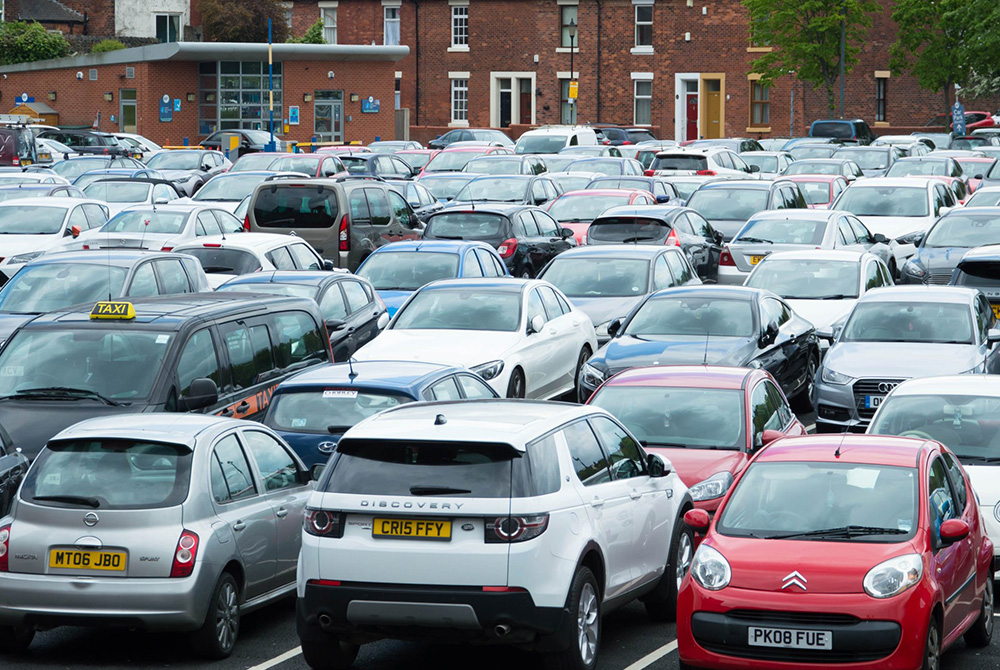
Simple forward bay parking reference points
Here are some easy, reliable reference points when you are doing the forward bay parking manoeuvre:
- For judging your turning point: Line up your car so that the first line of your chosen bay lines up with your door mirror, then start steering in.
- For checking your positioning: Keep your car about 1 to 1.5 car doors’ width away from the bays you will be turning into.
- For turning in: Check that the left and right bay lines appear evenly in your mirrors, without one creeping closer than the other.
- For ensuring your car is straight: The bay lines should run parallel through both side windows, and your steering wheel should be centred.
- For pulling in the correct distance: Stop when the front of the bay you are pulling into disappears beneath your windscreen, or you are a safe distance from the barrier.
Forward parking into a bay: a key skill that you will use for life
Being able to drive forward safely into a bay is a skill that you will no doubt often use in your future driving, so it is important to get it right. As with all manoeuvres, practice makes perfect, ensuring that you take it slow and stay observant.
Wherever you are in the country, whether you are taking driving lessons in Ipswich, Glasgow or Aberystwyth, our expert instructors can give you calm, practical coaching so that you quickly master this manoeuvre. With the right technique and some patience, you will soon find yourself gliding forward neatly into bays with confidence.

Written by Anthony Johnson
Grade A - 51/51
ORDIT Registered Trainer