Trying to overtake cyclists can be tricky, especially when you are on your driving test. Sometimes we overanalyse it, become hesitant, or make rash decisions, such as trying to overtake a cyclist on a bend, or opposite a junction.
Whether you have your driving test coming up soon or you just want some tips on how to overtake cyclists, we’ve got your questions covered below.
- What is the law on overtaking cyclists?
- What is in the Highway Code for overtaking cyclists?
- Are there fines for overtaking cyclists if you don’t give enough room?
- How much room should you leave when overtaking a cyclist?
- Can you overtake a cyclist on a broken white line?
- Can you overtake a cyclist on double white lines?
- Do you have to indicate when overtaking a cyclist?
- Where should you never overtake a cyclist?
- Common mistakes to avoid
- How to overtake cyclists safely
- Safety tips for drivers overtaking cyclists
- Can cyclists overtake you?
What is the law on overtaking cyclists?
When overtaking cyclists, drivers must follow key legal requirements. These have been designed to keep cyclists safe, as they are some of the most vulnerable road users.
The legal requirements are as follows:
- Leave at least 1.5 metres between you and the cyclist when overtaking at speeds of up to 30mph. At higher speeds, you should allow even more room.
- Only overtake when it is safe and legal to do so. If there is oncoming traffic, limited visibility, or not enough space, you must wait behind the cyclist.
- Don’t cut in too quickly after overtaking. You should return to your lane only when you are safely ahead of the cyclist.
- You may cross a solid white line to overtake a cyclist if necessary, provided it is safe to do so, and you can complete the manoeuvre without speeding or putting anyone at risk.
- Take extra care. Cyclists may need to move out to avoid hazards such as potholes, parked cars, or drains, so you must drive cautiously near them.
Failing to follow the above could result in penalties for careless or dangerous driving.
Knowing the law is important, but understanding how to apply it is what will make you a safer driver. The Highway Code breaks this down into clear, practical rules.
What is in the Highway Code for overtaking cyclists?
Here are the key rules regarding driving alongside cyclists, explained in more detail:
- Rule 162: The rule states that, before attempting to overtake a cyclist, you must review the road ahead to ensure that it is clear without oncoming traffic. There must also be a large gap in front of the cyclist so that you can pass them without having to cut in quickly.
- Rule 163: This rule states that when you overtake, you must leave plenty of room between you and the cyclist. They recommend leaving as much room as you would when overtaking a car. Do not prolong overtaking. Once you have moved out to go around the cyclist, continue to overtake quickly in case a vehicle suddenly appears ahead. Once you have passed the cyclist and are at a safe distance ahead, move straight back over into your lane.
- Rule 140: This rule relates to cycle lanes. When approaching a cycle lane, there will be visible signs and road markings. If the road marking is a solid white line, it means you cannot stop, park or drive in this lane; it is for cyclists only. A dashed line indicates an advisory cycle lane, meaning you can enter the lane but only if it is absolutely unavoidable, for example, if there are road works and you are forced to drive into the lane to go around them.
Are there fines for overtaking cyclists if you don’t give enough room?
Yes, drivers can be fined for overtaking cyclists if the manoeuvre is unsafe. While there is no specific offence for overtaking a cyclist, if you don’t do it safely or give insufficient room, it can be treated as careless or dangerous driving.
For example, passing too closely or overtaking when there is oncoming traffic could result in a £100 fine and 3 penalty points. In more serious situations, drivers may face higher fines, additional points, or a driving ban.
This is why it is important to only overtake cyclists when you can give them plenty of space and complete the manoeuvre safely.
How much room should you leave when overtaking a cyclist?
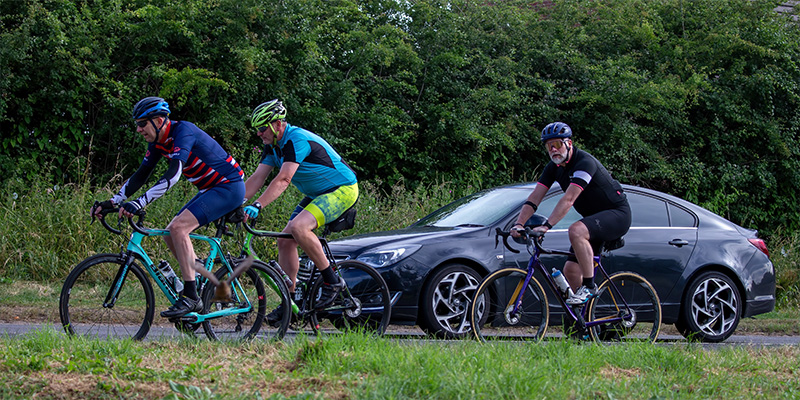
You should leave plenty of room between you and the cyclist. Do not overtake a cyclist unless you can pass them with at least 1.5 metres between them and you. To gauge a metre, imagine the length of an open car door. Ideally, if possible, leave the width of a car.
Always apply a “less space, less speed” approach. This means that if you are passing them at 60-70mph, you need to leave plenty of space to allow for gusts of wind, sudden changes of direction, and more.
Be extra cautious when overtaking in a busy, congested area. For example, if you are taking driving lessons in Oxford, cyclists are common in the city centre, where there are also other cars and many pedestrians. Give yourself enough space, watch out for everything around you, and don’t rush. Be prepared to slow down or wait if anything could put the cyclist at risk.
Can you overtake a cyclist on a broken white line?
Yes, you can cross a broken white line to overtake a cyclist if the following applies:
- The nearest line to you is a broken white line.
- There is enough space and visibility to overtake safely.
- You can return to your lane before reaching a solid white line on your side.
White directional arrows will show when you need to return to your side of the road, so you must complete your overtake before you get to them.
Can you overtake a cyclist on double white lines?
As a general rule, you should not overtake crossing double white lines if the nearest to you is a solid line.
However, Rule 129 of the Highway Code provides a legal exception allowing you to overtake a cyclist over double white lines. Under this rule, you can cross double white lines to overtake a slow-moving road user, such as a cyclist, if the cyclist is travelling at 10mph or less.
However, you must still check that it is safe, with good visibility, and ensure that there is no oncoming traffic before you overtake. If there is any doubt, it is safer to stay behind the cyclist.
Do you have to indicate when overtaking a cyclist?
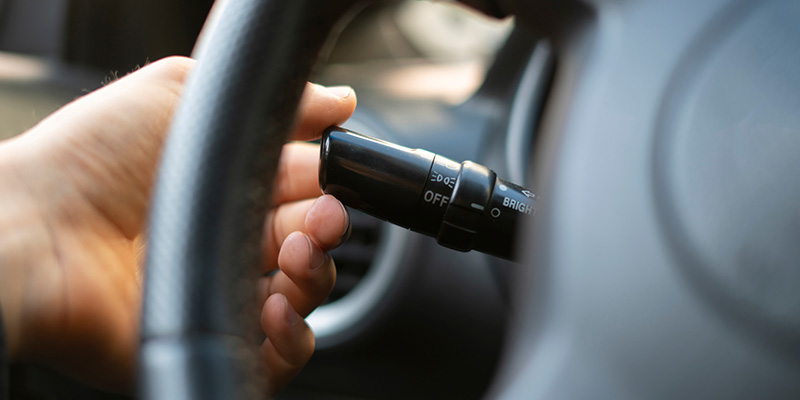
You do not always need to indicate when overtaking a cyclist – you should determine first if it will help or confuse other road users.
Examples of when you should indicate when overtaking:
- * If you are planning to cross into the opposing lane of traffic to overtake, you should wait for a suitable gap and signal to warn oncoming traffic that you are planning to cross into their lane.
- If it’s not obvious to traffic following you that you plan to overtake then signalling can let vehicles behind you know your plans.
Examples of when you do not need to indicate when overtaking:
- If a signal would confuse other road users, for example at a roundabout or junction.
- If the road is wide, you have plenty of space to overtake without having to cross into oncoming traffic and your plan to overtake is obvious to other road users, a signal might not be necessary.
Also, after passing a cyclist, it’s rarely necessary to signal again. On a dual carriageway, if you are about to change lanes again, then signalling may help inform other road users what you are doing. On a single carriageway, signalling again is unlikely to add any benefit.
Where should you never overtake a cyclist?
If you are considering overtaking a cyclist, never do it if the following apply:
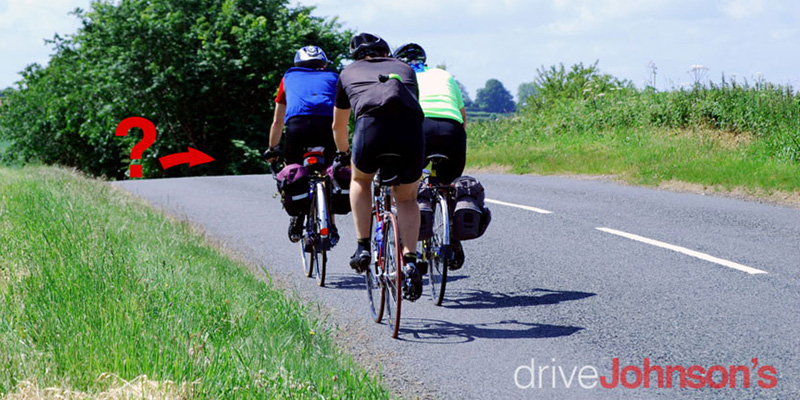
- On bends, especially where you can’t see what’s around the corner.
- When approaching a road junction such as a T-Junction or roundabout.
- If they look like they are going to change direction – watch out for their body language and arm signals.
- If there is not enough room to do so (see above).
- If they are approaching puddles or potholes. They’re likely to steer around them.
- If it means splashing them with a large puddle.
- When on the brow of a hill or approaching dead ground. This is more common when taking your driving lessons in Colchester and similar areas, where popular routes can involve rural roads.
- If a cyclist seems prepared to overtake another road user. If this happens, hold back and let them perform their overtake first.
Common mistakes to avoid
Never sound your horn at a cyclist, unless it’s an emergency and you need to make them aware of your presence. Sounding the horn may startle them, cause them to overreact and swerve into your path or someone else’s.
Never rev your engine as you pass them or suddenly put your foot down. This can be intimidating for cyclists and lead them to startle or take risks. Always remain respectful when you drive past.
How to overtake cyclists safely
Follow this step-by-step process to overtake cyclists safely:
- Check mirrors and assess the situation.
- Position slightly right towards the centre of the road to improve your visibility.
- Decide if there’s enough space.
- Move out early and smoothly.
- Pass the cyclist decisively but safely.
- Return to your lane only when you are fully clear and past the cyclist.
If there are several cyclists riding in a pack, you will need to be mindful of everyone. Look at their body language. Are they looking over their shoulders? Are they paying attention? If it’s safe, then proceed with the overtake.
If you are ever unsure, it is always safer to wait behind them than risk a dangerous overtake.
Safety tips for drivers overtaking cyclists
Sharing the road with a cyclist shouldn’t be a worry. Here are our top tips on how to remain safe when driving alongside cyclists:
Weather conditions: Always be extra wary around cyclists in bad weather. Allow cyclists extra room when driving in the wind, as they are more likely to swerve. This is the same when driving in the rain, as cyclists can suddenly slip or get caught out by a hidden pothole.
Location: Only ever overtake on a wide road. Never overtake on a narrow country road or a tight bend.
Observations: As a driver, you should always be aware of your surroundings, keeping your eye on the road and blind spots. This will help you to react quickly should a hazard suddenly appear or things not go to plan.
MSPSL: Always apply the MSPSL routine when overtaking cyclists and motorbikes. If you see something in your mirrors approaching from behind, re-check your mirrors before continuing the routine. Sometimes, you need more than one check in the mirrors to work out if a vehicle is going to try to pass you. If a vehicle passes, restart the routine. In some instances, such as going up a hill, you may need to drop down a gear to overtake the cyclist cleanly, clearly and swiftly. If it helps, break the routine down to M, S, P, S, G (gear), L.
Signalling: Unlike vehicles, cyclists must signal their turns using hand signals. However, never presume you know what a cyclist will do, even if they signal clearly. It is always safest to wait until the cyclist has started to make the turn before following behind or driving past.
Traffic lights: Many traffic lights consist of both a lane for vehicles and a lane for cyclists, particularly in busy city areas or coming up to a large roundabout. Even if this is not the case, always allow time for the cyclist to move off first when the traffic lights turn green. Never try to cut out ahead or overtake.
Stay calm: Cyclists may sometimes move ahead of traffic at lights. If this happens, remain calm and give them space. Your vehicle has a lot more power than their bicycle, and reacting to them risks an accident.
Consider every cyclist on an individual basis: Their positioning, confidence, and awareness can give you clues about their experience. Inexperienced road users and cyclists without helmets should be approached with even more caution.
Can cyclists overtake you?
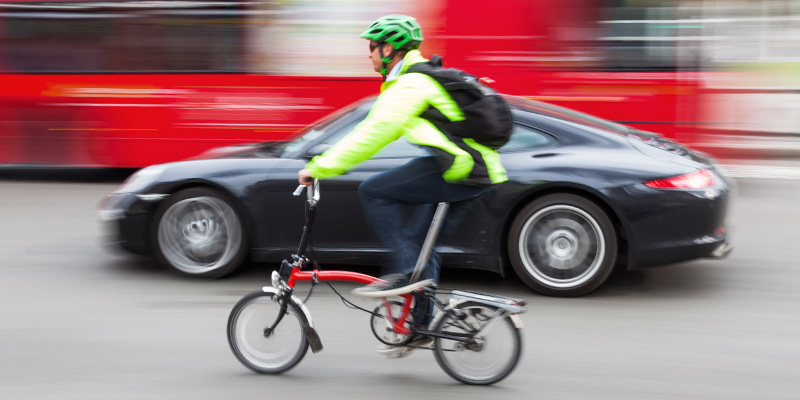
Yes, cyclists can overtake cars, and they do not always have to pass on the right-hand side.
In slow or stationary traffic, cyclists often filter through gaps and may pass on the left. While this is allowed, it can make them harder to spot if you are not checking your mirrors carefully.
This is why it is important to always stay aware of your surroundings, especially before turning or moving off.
Learning to share the road
Driving alongside cyclists is becoming a normal part of everyday traffic. The amount of practice you get at this will depend on your local area and how cycling is encouraged there. For example, if you are having driving lessons in Sheffield, they have introduced cycling lanes, rental schemes and road cycling clubs, increasing the popularity of cycling. In areas such as these, you will quickly become comfortable with how to safely share the road.
Even if you do not have much opportunity to practice because there are not many cyclists near you, stay cautious and respectful when you do come across them on the road. The more awareness and patience you show, the safer the road will be for everyone.

Written by Anthony Johnson
Grade A - 51/51
ORDIT Registered Trainer